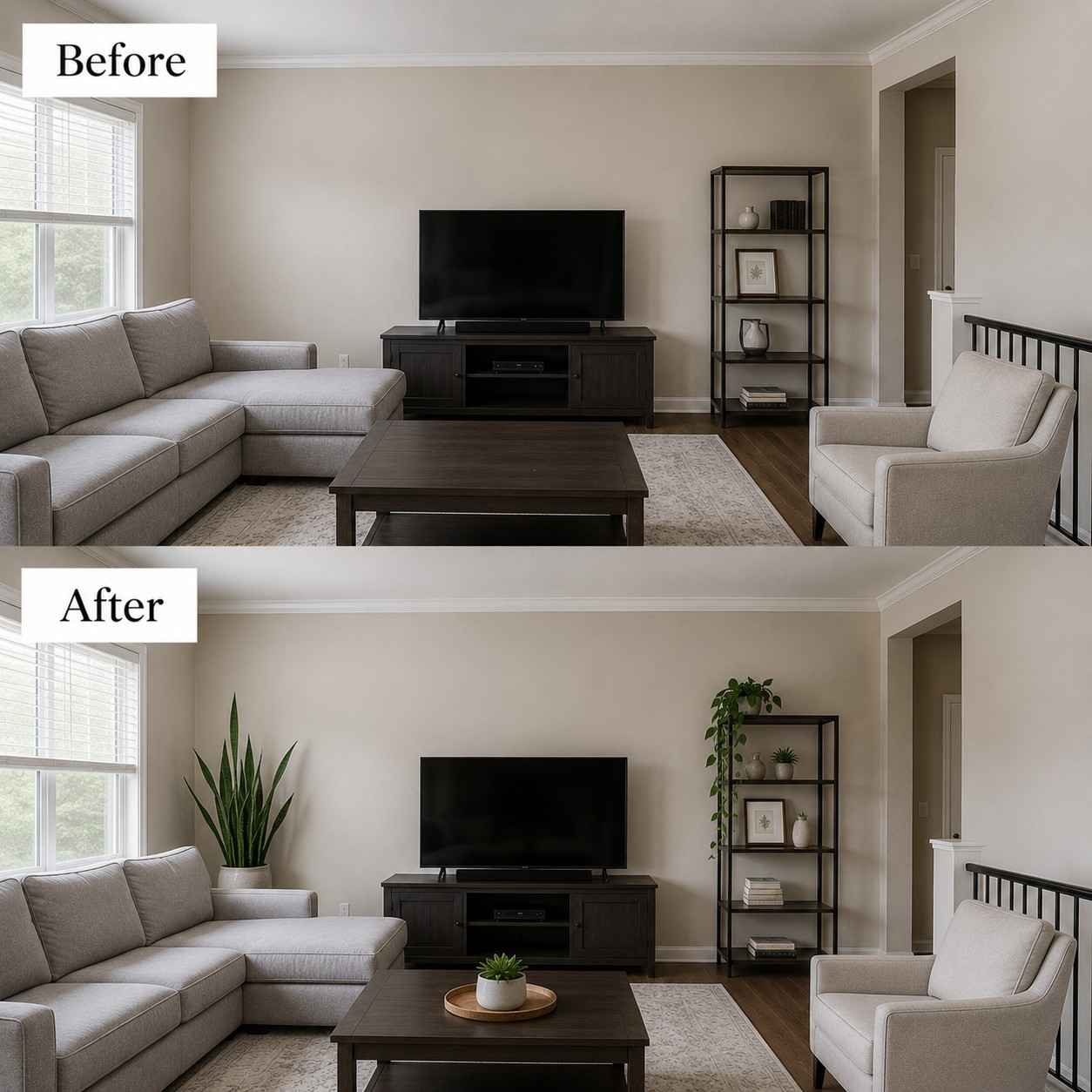
The Living Room Makeover on a Budget — Why It Matters More Than Ever
The living room is the most used, most seen, and most emotionally significant room in most homes. It is where families gather, where friends are received, where the day begins and ends, and where the accumulated quality of a home’s design is most immediately felt. And yet it is also the room that is most frequently neglected, compromised, and left to slowly deteriorate from its best intended state into a collection of mismatched decisions, inadequate lighting, and surfaces that communicate nothing more specific than ‘we didn’t quite get around to it.’
The before-and-after format of this guide is intentional. Understanding specifically what was wrong with a space before an intervention and precisely what changed after it is far more useful than a collection of aspirational ‘after’ photographs with no context. The before-and-after structure also mirrors the most saved and most engaged content format on Pinterest — because it validates the aspiration with evidence of achievability and makes the reader’s own situation feel not just improvable but specifically improvable by the technique being described.
Each of the 25 ideas in this guide includes a specific budget estimate, a before description, an after description, a detailed explanation of the technique and its implementation, a professional styling tip
Budget Strategy: How to Allocate $200 for Maximum Room Transformation
If working with a $200 total budget for a complete living room makeover, the following allocation maximises visual impact across every room surface:
- Free first — rearrange furniture + declutter edit: $0
- Accent wall paint (one wall): $25–40
- Pendant ceiling light replacement: $30–45
- Large rug or layered rugs: $25–50
- New cushion covers for sofa (5–7 covers): $30–45
- One throw blanket: $20–30
- Plants and terracotta pots (3 plants): $15–25
- Dried botanicals and vase for mantelpiece: $15–20
- Gallery wall frames and free prints: $15–25
- Candles and string lights for evening: $15–20
- Total: $190–$300 — achievable within $200 by sourcing some items second-hand
5 Principles That Make Budget Makeovers Look Expensive
1. Colour coherence above all
Choose one dominant colour, one secondary colour, and one accent before buying anything. Apply these consistently across paint, textiles, and accessories. Colour coherence is what makes individually affordable items read as a cohesive, designed whole.
2. Fix the lighting first
No room looks expensive under bad lighting. Replacing a harsh ceiling light and adding a table lamp costs under sixty dollars and immediately changes how every other element in the room reads. Light quality is the great equaliser of budget and expensive design.
3. Scale matters more than price
A correctly sized rug in a budget material looks more expensive than a premium small rug. A correctly proportioned frame for a print looks more expensive than an ill-fitting expensive frame. Getting scale right is free and makes everything look more considered.
4. Texture over pattern
In a budget living room, texture — bouclé, linen, chunky knit, jute, velvet — adds visual richness without requiring the colour or pattern commitment of more assertive choices. Layer textures generously and the room will feel substantially more expensive than its components individually justify.
5. Negative space is not empty space
The budget makeover temptation is to fill every surface with new, affordable objects. Resist it. The rooms that look most expensive have the most breathing space around every object. Edit ruthlessly, display thoughtfully, and let the empty surface do its work.
The 25 Before & After Living Room Makeover Ideas
Each idea below includes: a before state, an after state, detailed implementation guidance, a styling tip, two AI image prompts (before and after), and two alt texts (before and after).
1. The $30 Paint Transformation: One Accent Wall That Changes Everything
Budget: $20–$40
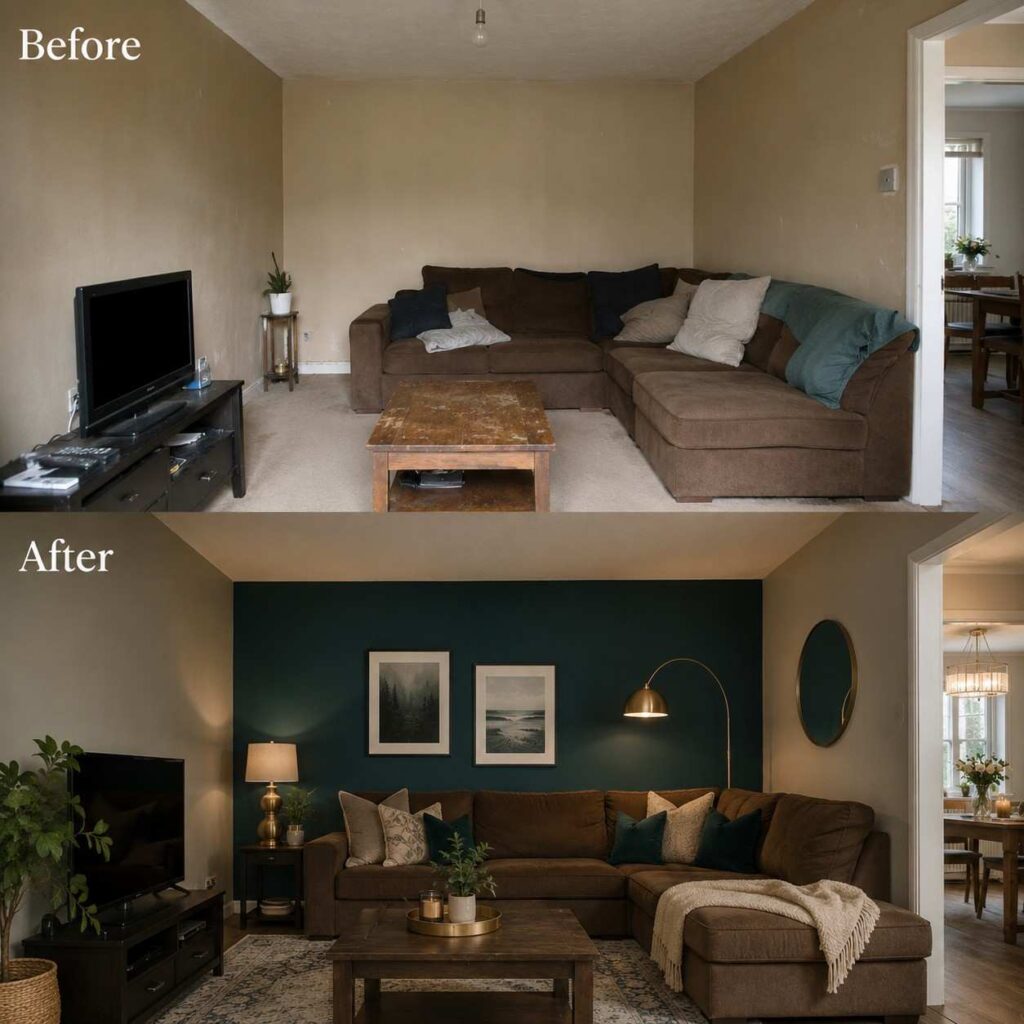
Paint is the single most cost-effective transformation available to any room, and the living room accent wall is its most dramatic application. The concept is simple but psychologically powerful: by painting one wall in a bold, saturated colour while leaving the remaining three walls in their existing neutral tone, you give the room an immediate focal point, a sense of architectural definition, and a depth and character that four bland walls can never achieve. The transformation is achieved for the price of a single tin of paint — typically between fifteen and thirty-five dollars — and a few hours of effort.
Style tip: After painting your accent wall, rearrange every accessory in the room to create contrast against the new colour — white cushions, natural wood objects, and brass or gold accessories all pop magnificently against a deep-toned accent wall.
2. The $50 Cushion Cover Swap: Transforming a Sofa Without Buying a New One
Budget: $30–$60
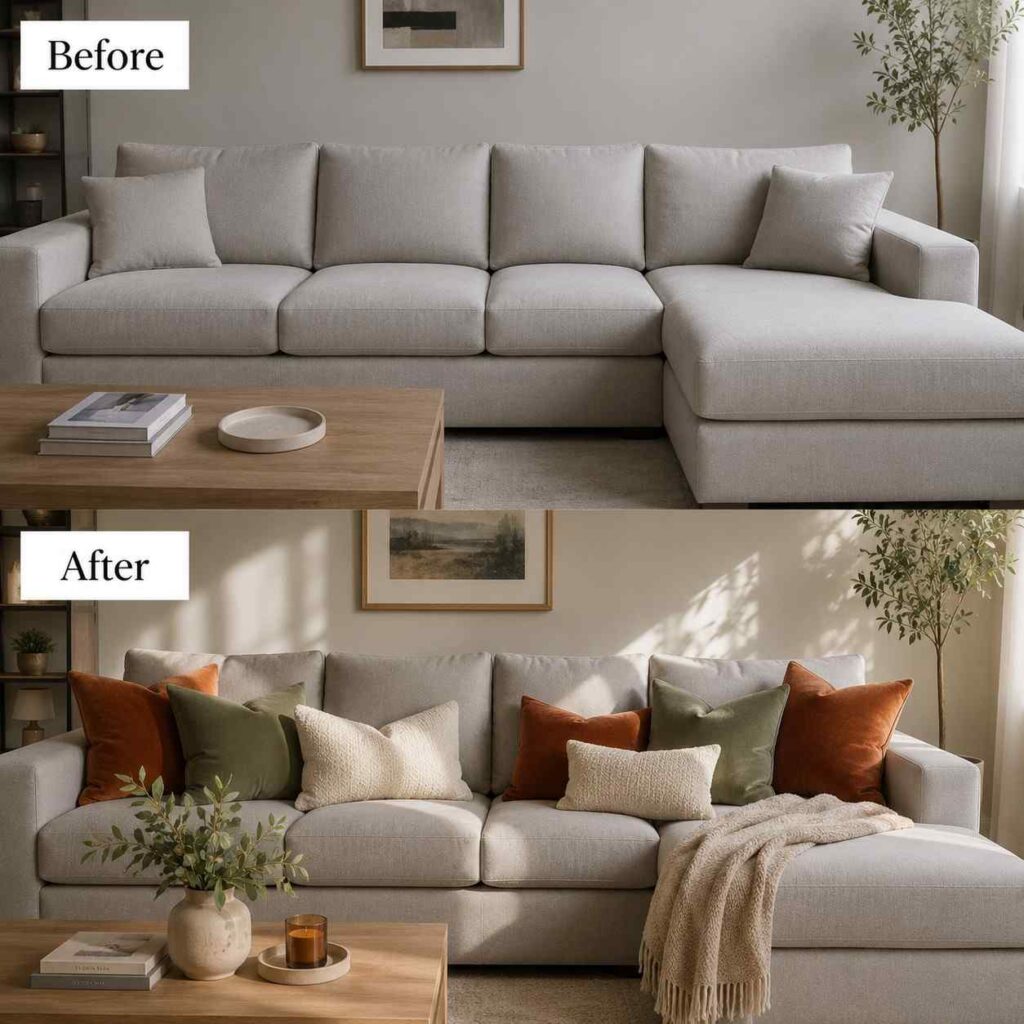
The cushion cover swap is one of the most consistently underestimated budget living room transformations available — and one of the most immediately effective. It works because the sofa is the visual centrepiece of most living rooms, occupying more floor area and attracting more visual attention than any other single object. A sofa dressed with beautiful, thoughtfully chosen cushion covers in rich colours and varied textures reads as dramatically more considered and more expensive than the same sofa with flat, uninspiring covers — regardless of the underlying cost of either the sofa or the
Style tip: Use the rule of odd numbers for cushion styling — three or five cushions on a standard sofa look more naturally styled than two or four. Arrange by size: largest at the back, smallest at the front.
3. The $40 Rug Layering Trick: Instant Warmth, Texture, and Visual Depth
Budget: $25–$60
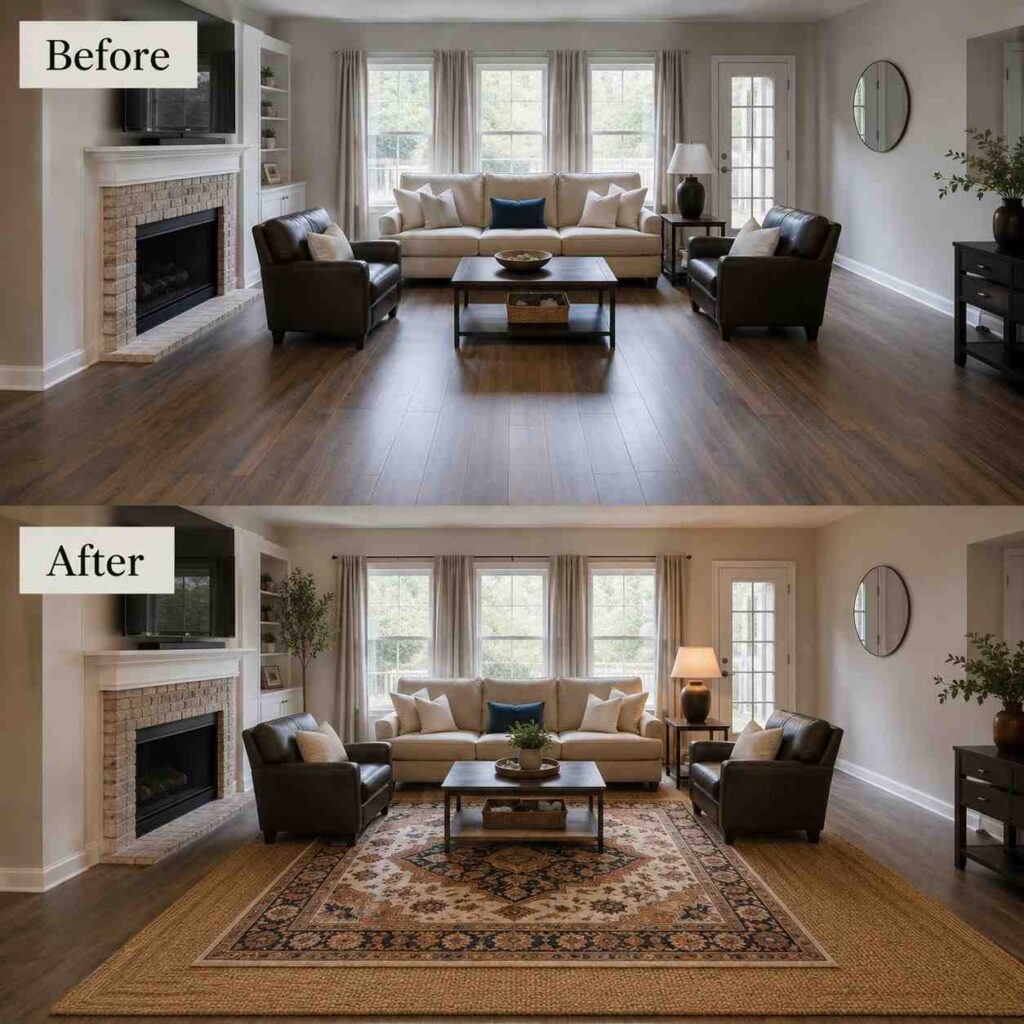
The rug is the single most impactful floor covering decision in a living room, and the layered rug technique is its budget-friendly superpower. By placing a smaller, more decorative rug on top of a larger, plainer base rug, you create a layered visual effect that reads as considerably more expensive and considered than either rug would achieve alone. The base rug — typically a plain jute, sisal, or cotton flatweave in a neutral tone — provides the sizing and anchoring function, while the top rug provides the pattern, colour, and personality. The combination costs less than a single quality rug while producing a richer, more layered result.
Style tip: When layering rugs, angle the top rug slightly — not parallel to the walls but turned five to ten degrees — for a naturally styled, effortlessly casual look that interior designers use consistently.
4. The Free Furniture Rearrangement: The $0 Makeover With Maximum Impact
Budget: $0
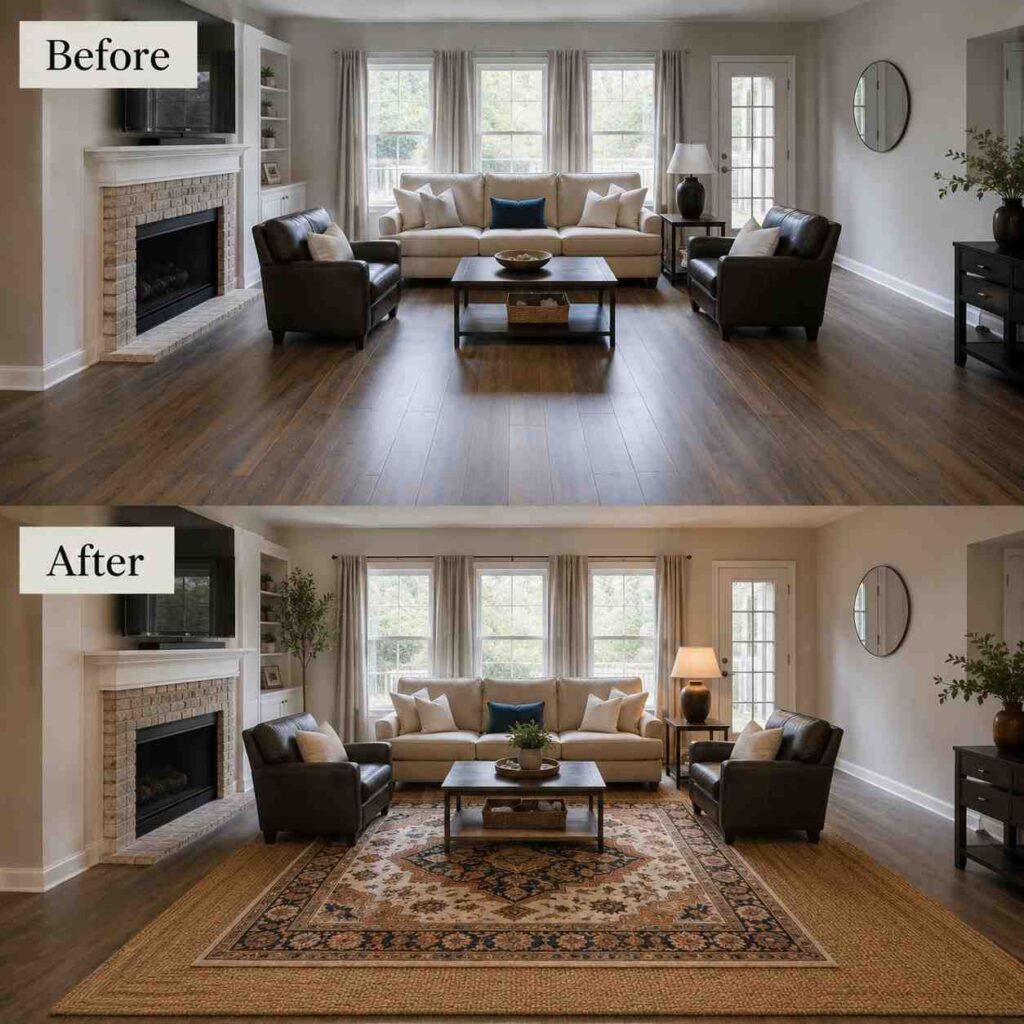
The furniture rearrangement is the most frequently overlooked and most completely free living room transformation available — and the results are often so dramatic that they are mistaken for more expensive interventions. The single most common furniture arrangement mistake in living rooms is the perimeter placement error: pushing every piece of furniture against the walls in the belief that this makes the room feel larger. It does not. It creates a hollow, empty centre surrounded by furniture that nobody enjoys sitting in, an atmosphere of institutional formality, and the complete absence of the intimate, gathered quality that makes a living room function as a social space.
Style tip: Once you have rearranged your furniture, test the new arrangement by sitting in every seat in the room and assessing: can I comfortably reach the coffee table? Can I make eye contact with the other seats? Does the focal point feel engaging? If yes to all three, the arrangement is working.
5. The $25 Gallery Wall Transformation: From Bare Walls to Personal Art Museum
Budget: $15–$45
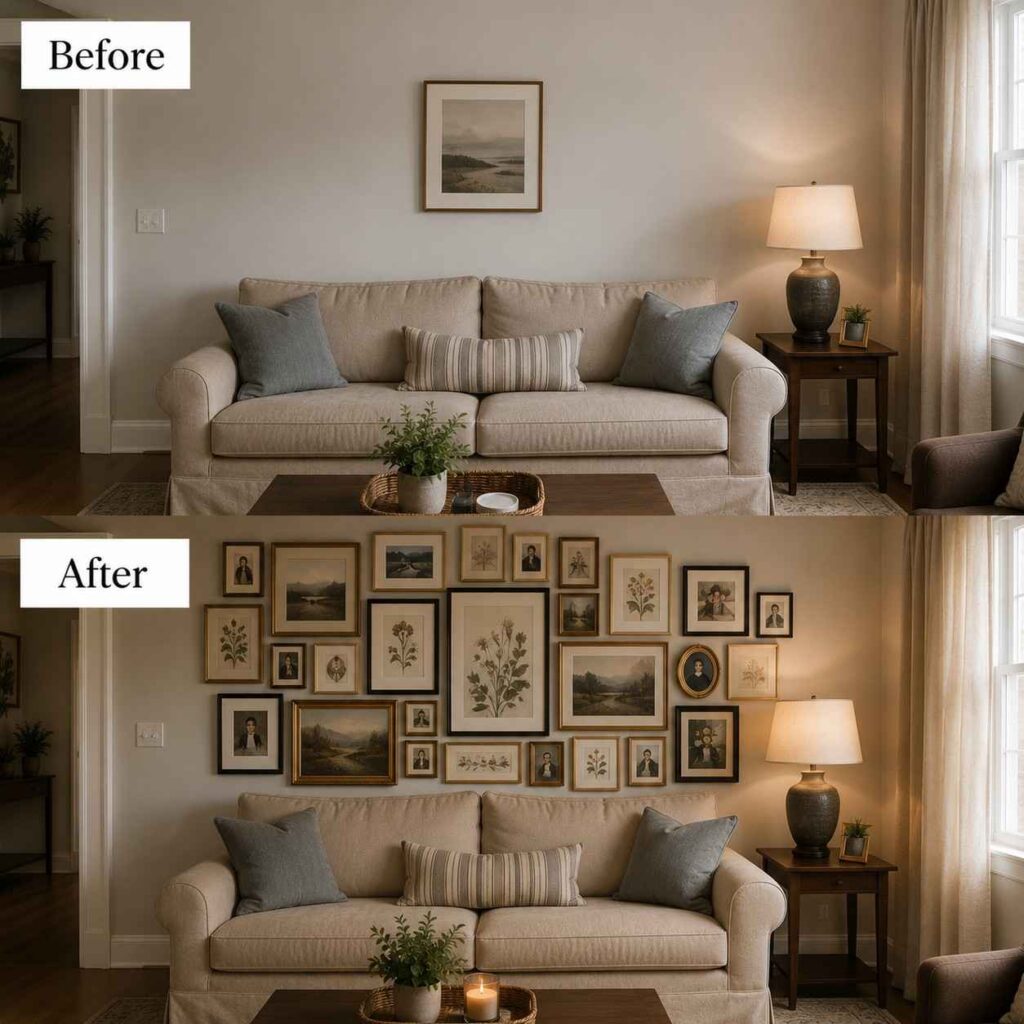
A gallery wall is one of the most powerful personalisation tools available at any budget — and when executed with care and coherence, it delivers a visual impact that rivals the most expensive single-piece artworks at a fraction of the cost. The key to a budget gallery wall that looks genuinely considered rather than accidentally assembled is coherence: in the choice of frame finishes (mismatched frames work when unified by the same paint colour or the same material — all black, all gold, all natural wood), in the artwork selection (a shared colour palette ties diverse subject matter into a cohesive collection), and in the wall arrangement (spacing no more than five to eight centimetres between frames for a collected, salon-style density).
Style tip: Include at least one piece of the child’s own artwork, one personal photograph, and one genuinely vintage print in your gallery wall — the combination of the personal, the historical, and the aesthetic creates a depth of meaning that all-print or all-photograph walls cannot achieve.
6. The $35 Curtain Upgrade: Floor-Length Panels That Make Ceilings Soar
Budget: $25–$55
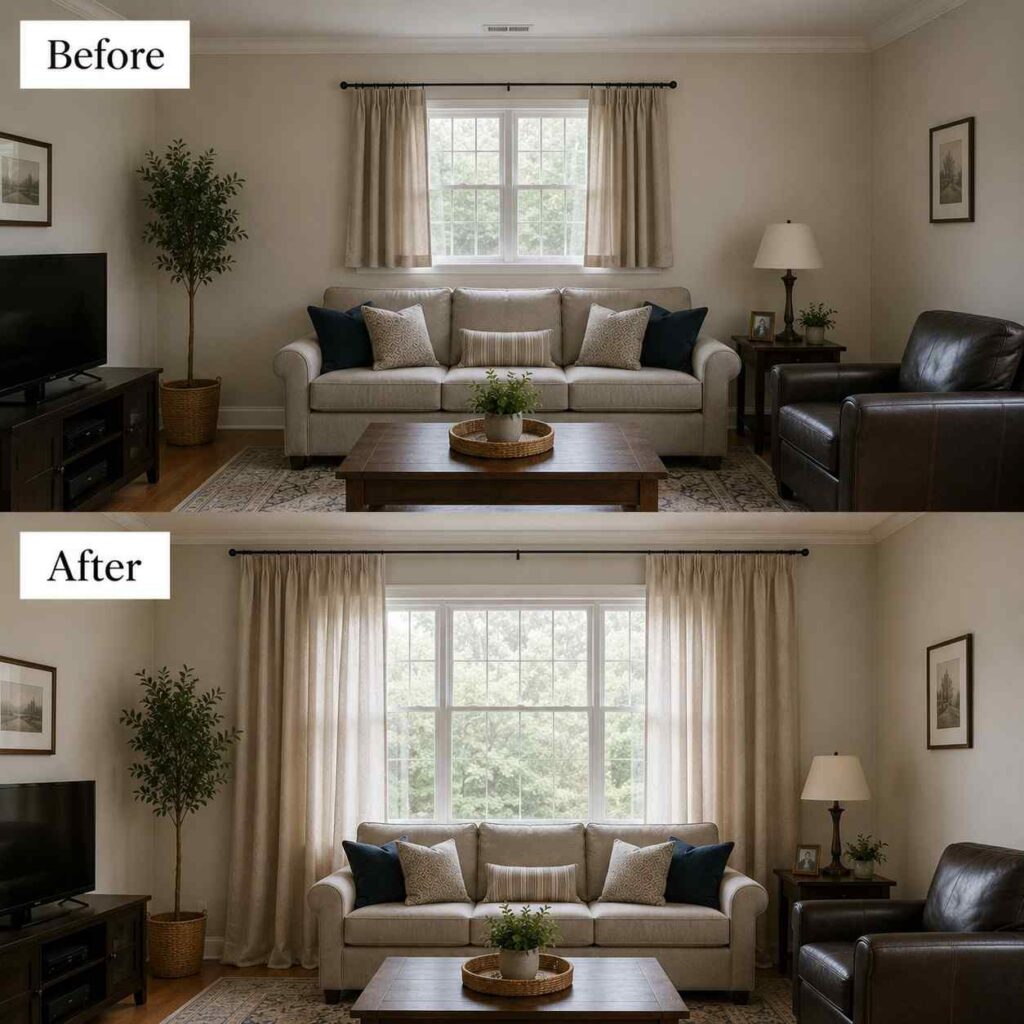
The curtain rod height mistake is one of the most common and most damaging errors in living room design, and correcting it is one of the cheapest and most dramatic improvements available to any budget makeover. When curtains are hung from a rod positioned directly above the window frame — at standard window height — they draw attention to where the window ends and make the remaining wall space above it look like an architectural error. When the same curtains are hung from a rod positioned close to the ceiling, the fabric creates an unbroken vertical line from ceiling to floor that makes the ceiling appear higher, the window appear larger, and the room appear significantly more spacious and designed.
Style tip: When hanging floor-length curtains close to the ceiling, use curtains that are ten centimetres longer than the floor-to-ceiling measurement to achieve a slight break or puddle on the floor — this intentional excess reads as luxurious rather than badly measured.
7. The $45 Lighting Swap: Replacing Ugly Ceiling Lights With Character Pendant Fixtures
Budget: $30–$60
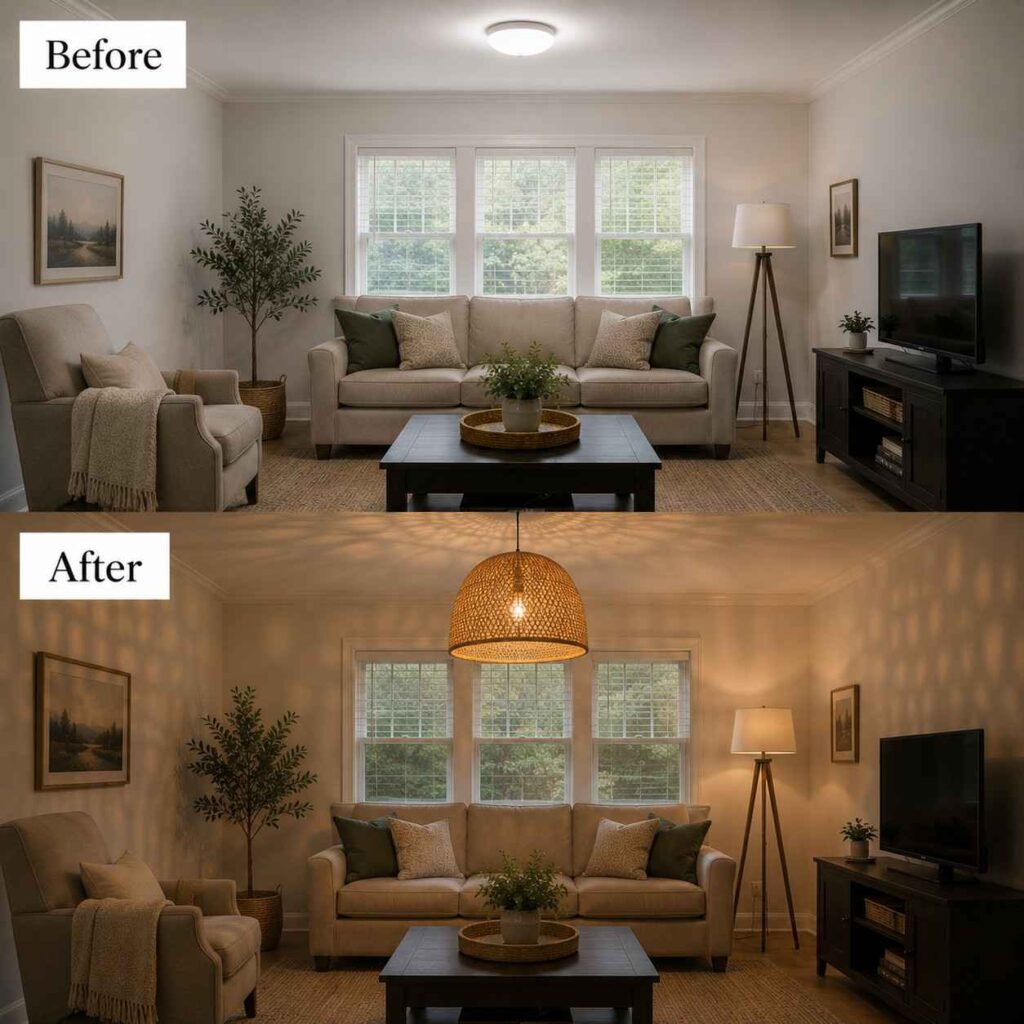
Lighting is the most consistently underinvested element in budget living room design, and the ceiling light fixture is its most visible failure point. The standard builder’s flush-mounted ceiling light — present in the majority of living rooms at the point of purchase or rental — produces flat, directionless illumination that reveals every surface at the same level of harshness, eliminates the atmospheric shadows and warm pools of light that make a living room feel genuinely inviting, and communicates, above all, that the room has not been thought about. Replacing it with a statement pendant fixture — even an inexpensive one — is one of the highest-impact budget living room changes available.
Style tip: Never use a single ceiling light as the only light source in a living room — add at least one table lamp and one floor lamp to create layered light at multiple heights, which is what gives a room a genuinely warm and welcoming atmosphere.
8. The $20 Plant Styling Makeover: Bringing the Natural World Into a Lifeless Room
Budget: $15–$35
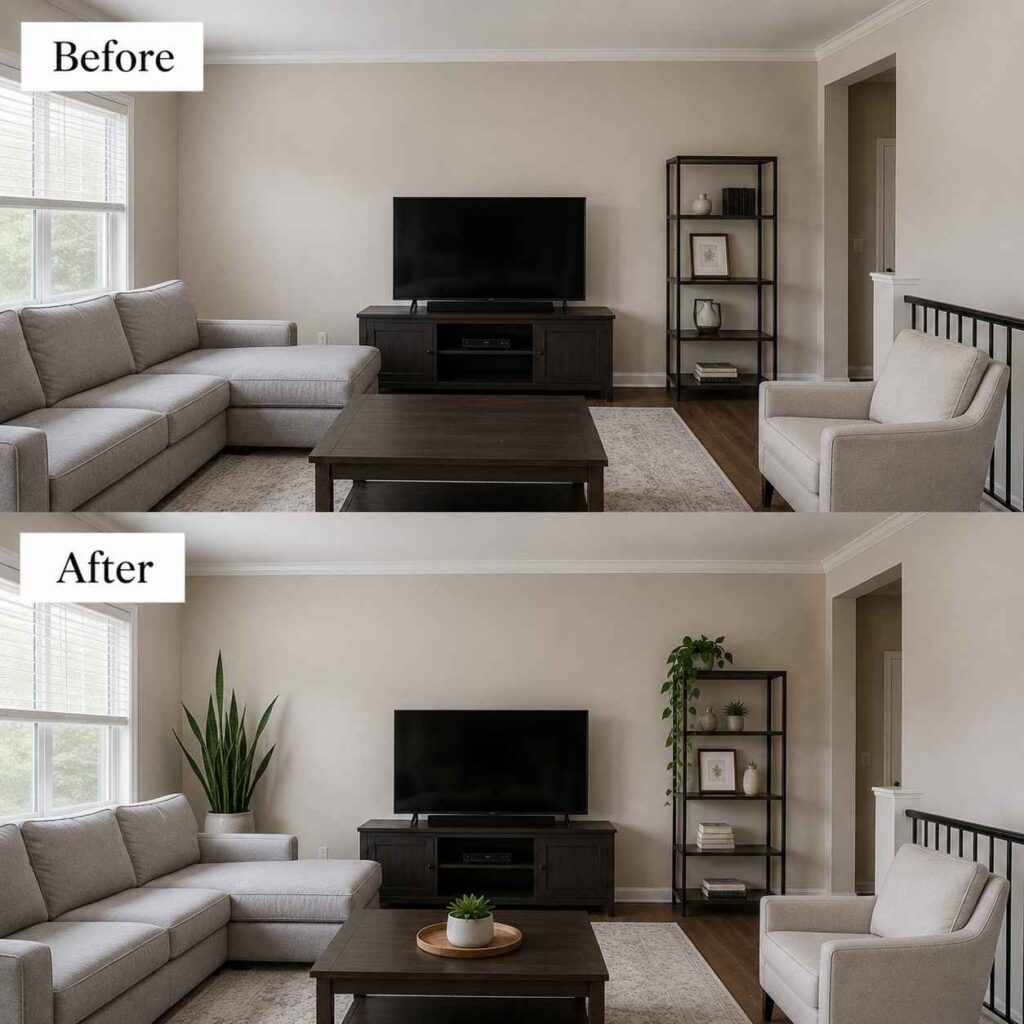
Indoor plants are one of the highest-impact, lowest-cost living room additions available, and their contribution to a room’s atmosphere goes far beyond the purely decorative. The physiological and psychological evidence for the restorative effect of indoor plants on human wellbeing is substantial: lower cortisol levels, reduced blood pressure, improved air quality, enhanced mood, and a measurable increase in the sense of calm and cognitive restoration that distinguishes a genuinely comfortable living room from a merely functional one. For a budget makeover, plants deliver all of this at a cost of a few dollars per specimen — making them the most extraordinary value for money available in the entire category of living room improvements.
Style tip: The most budget-friendly way to acquire a large specimen plant is from a plant swap group or a social media marketplace — large, mature plants that would cost sixty to one hundred dollars in a garden centre are frequently given away free by householders who can no longer care for them.
9. The $15 Mirror Trick: Doubling Light and Space for Almost Nothing
Budget: $10–$30
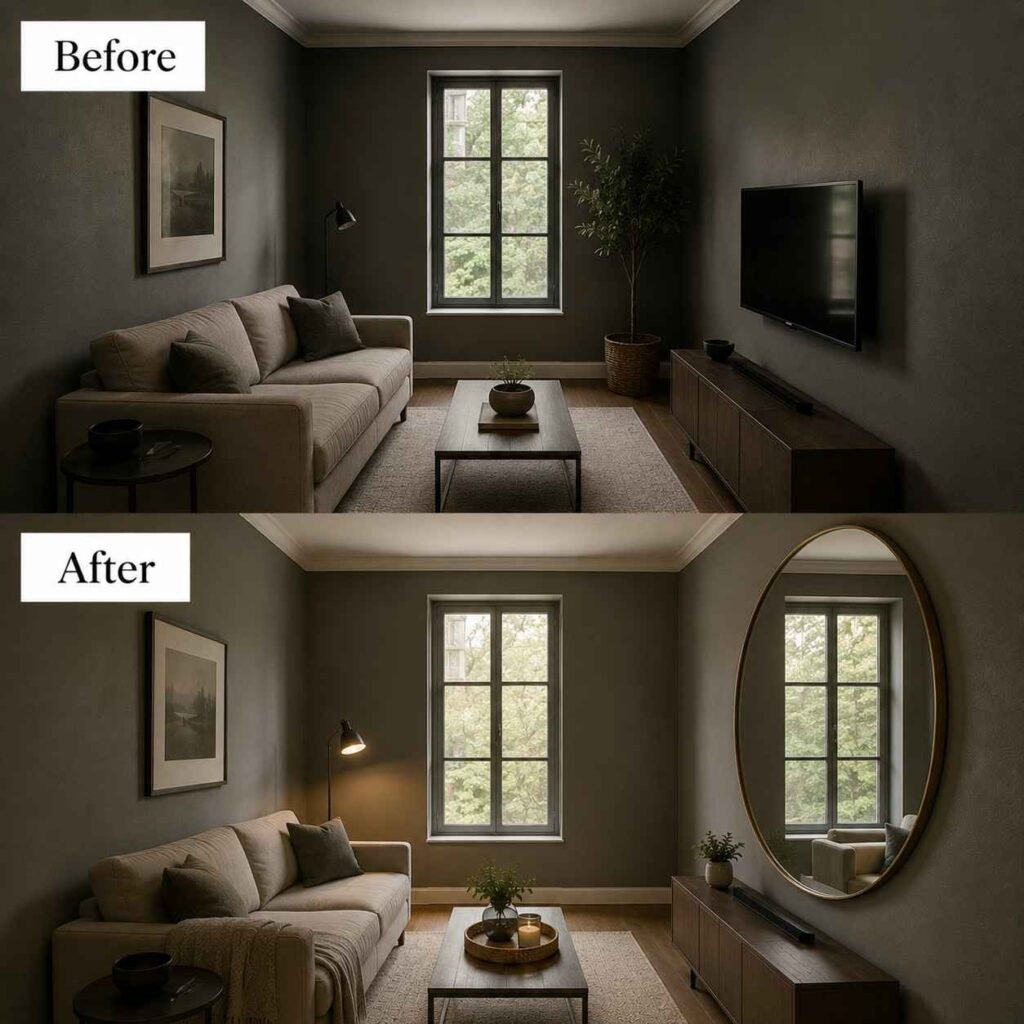
The mirror is the most effective optical trick available to a budget living room makeover — a single object that, correctly positioned, genuinely doubles the apparent light and volume of a room for a cost that can be as low as ten to fifteen dollars from a thrift store or discount retailer. The physics are simple: a mirror placed directly opposite or at a forty-five degree angle to the primary light source reflects that light back into the room, effectively adding the equivalent of a second window on the wall where the mirror hangs. In a small or dark living room, this effect is genuinely transformative.
Style tip: Never position a mirror so that it reflects a cluttered area, a bare wall, or an unappealing portion of the room — the mirror will amplify whatever it reflects. Before hanging, hold the mirror in position and look at what it will reflect. If the reflection is beautiful, proceed. If not, reposition.
10. The $55 Coffee Table Upcycle: From Scratched and Dated to Designer Statement
Budget: $30–$60
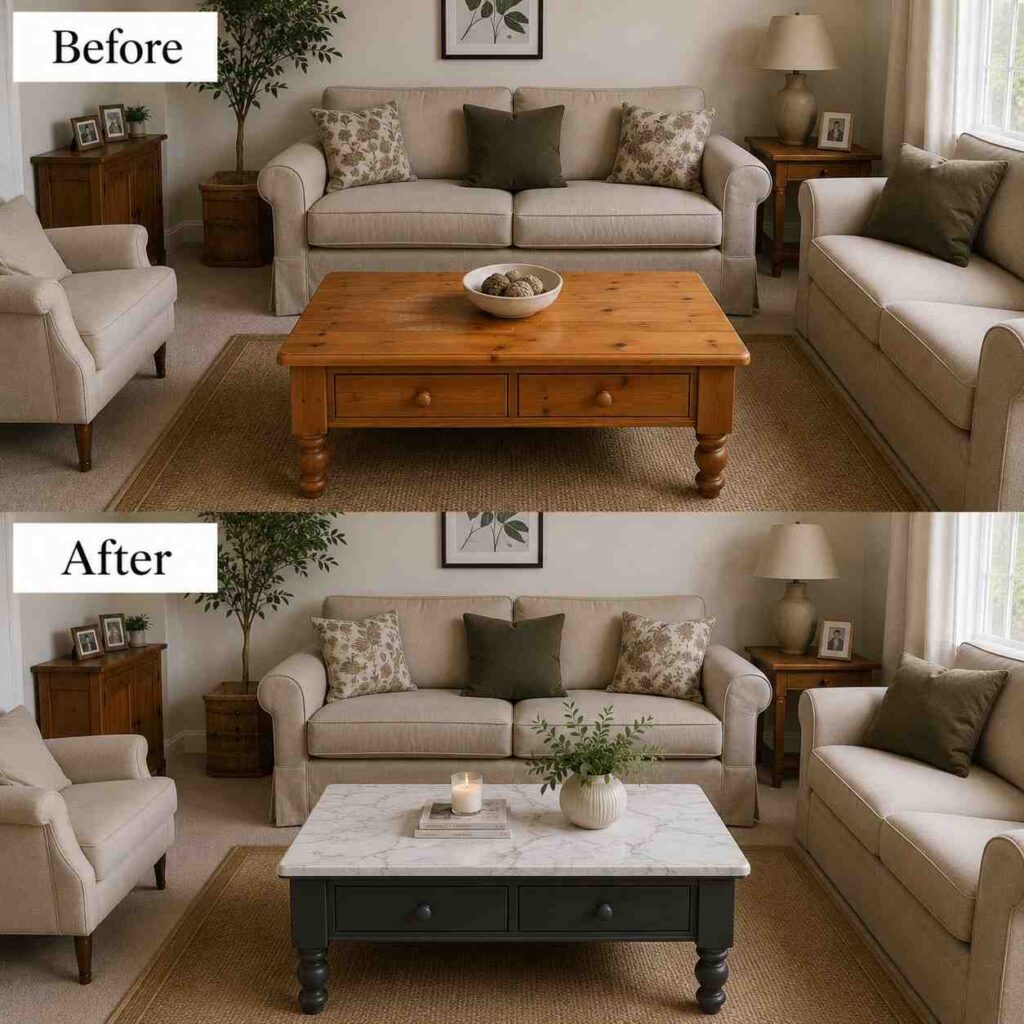
The coffee table upcycle is one of the most satisfying and most impactful budget living room projects available — a transformation that turns a structurally sound but visually outdated piece of furniture into something that genuinely looks designed and expensive. The technique requires no specialist tools, no advanced crafting skills, and minimal investment: chalk paint, which adheres to almost any surface without sanding or priming, and either a wax topcoat for a soft matte finish or a water-based varnish for greater durability in a high-use piece like a coffee table.
Style tip: When chalk painting a coffee table, distress the edges lightly with fine-grit sandpaper after the final coat — revealing a hint of the underlying colour or wood beneath. This intentional imperfection makes the piece look authentically aged and handmade rather than freshly painted.
11. The $35 Bookshelf Styling Overhaul: Turning Storage Into a Design Feature
Budget: $20–$40
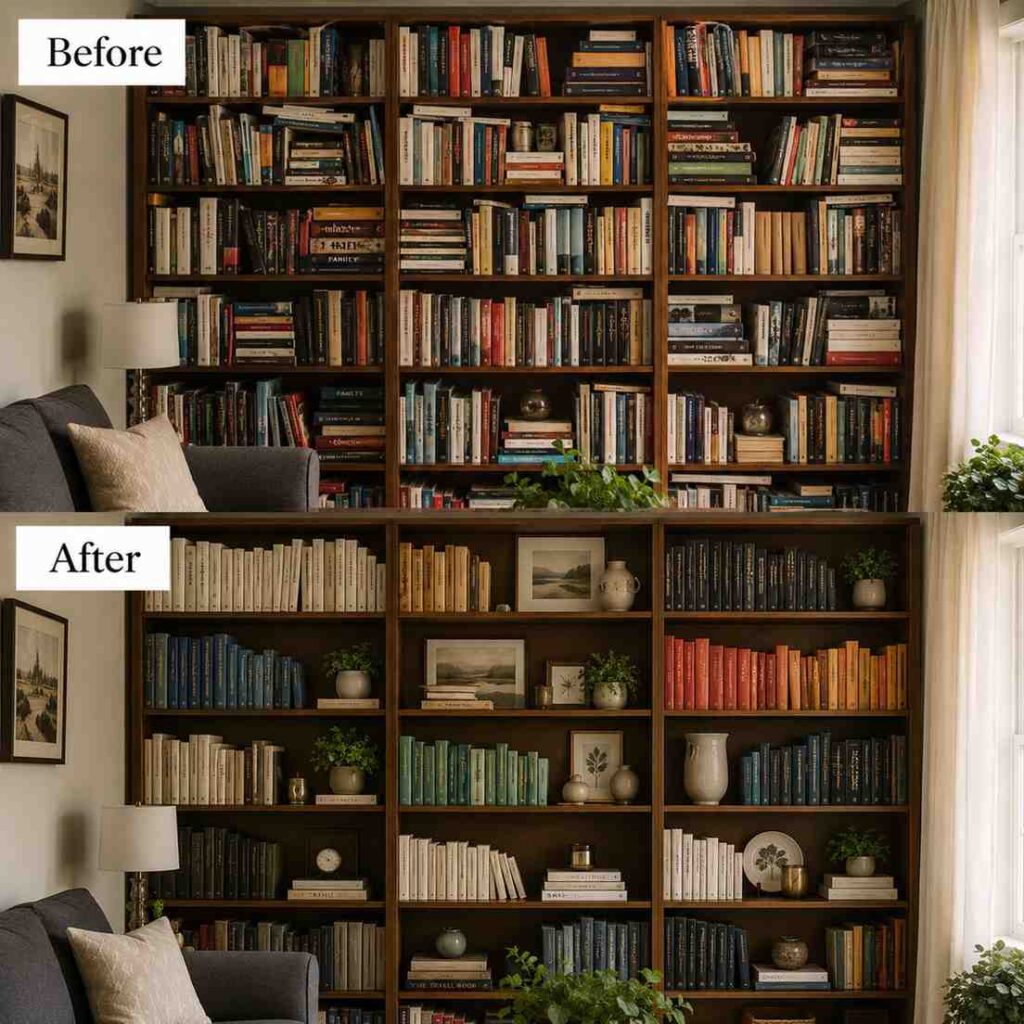
The bookshelf styling transformation is entirely free if you already own a bookshelf — it requires only the time to edit, rearrange, and introduce a small number of carefully chosen accessories from elsewhere in the home. The fundamental principle of effective bookshelf styling is the balance between books and objects: a shelf that is entirely books reads as a library; a shelf with no books reads as a display case. The most visually interesting and most aesthetically effective bookshelves combine the two in a ratio that reads as naturally accumulated rather than deliberately designed — typically sixty to seventy percent books and thirty to forty percent objects.
Style tip: Remove the dust jackets from hardback books — the cloth covers beneath are almost always more beautiful, more varied in tone, and more interesting in texture than the printed jackets, and their absence immediately elevates the visual quality of a book display.
12. The $40 Throw Blanket Transformation: Warmth, Texture, and Instant Luxury
Budget: $20–$45
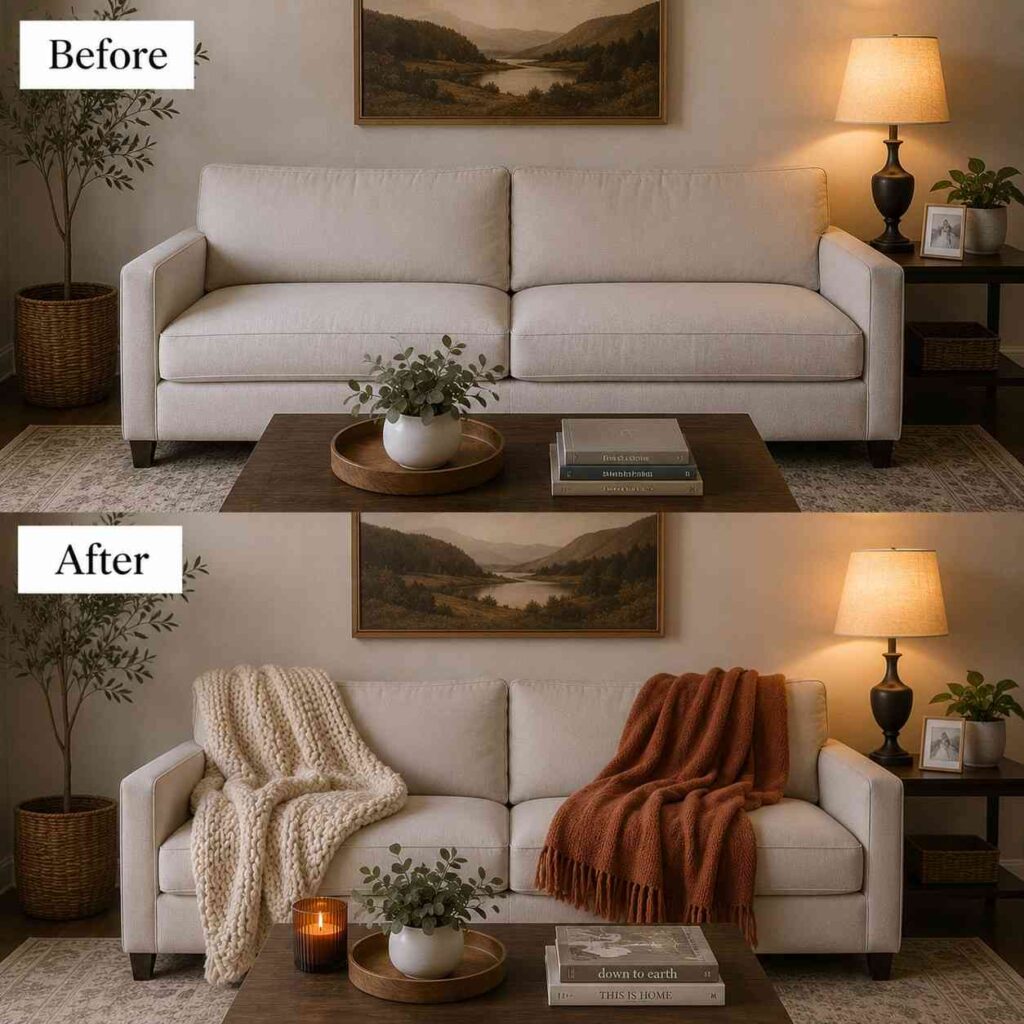
The throw blanket is the most versatile and most immediately impactful textile accessory available for a budget living room makeover — a single object that simultaneously adds colour, texture, warmth, and the crucial quality of apparent comfort that makes a living room genuinely inviting. The art of the throw is in its arrangement: the difference between a throw that looks styled and one that looks abandoned is entirely in how it is draped. A throw that has been carefully arranged — folded in thirds and draped over the arm of a sofa, or loosely gathered and laid across a seat cushion as if it has just been used and set aside — reads as both decorative and genuinely functional, which is exactly the quality that makes a living room feel like a real home.
Style tip: The most naturally styled throw arrangement is the one that looks as if it was just used — drape it loosely rather than folding it perfectly, allow a corner to drop toward the floor, and resist the temptation to smooth it flat. Apparent ease is the aesthetic.
13. The $25 Vase and Dried Botanicals Styling: Nature-Inspired Elegance for Almost Nothing
Budget: $15–$30
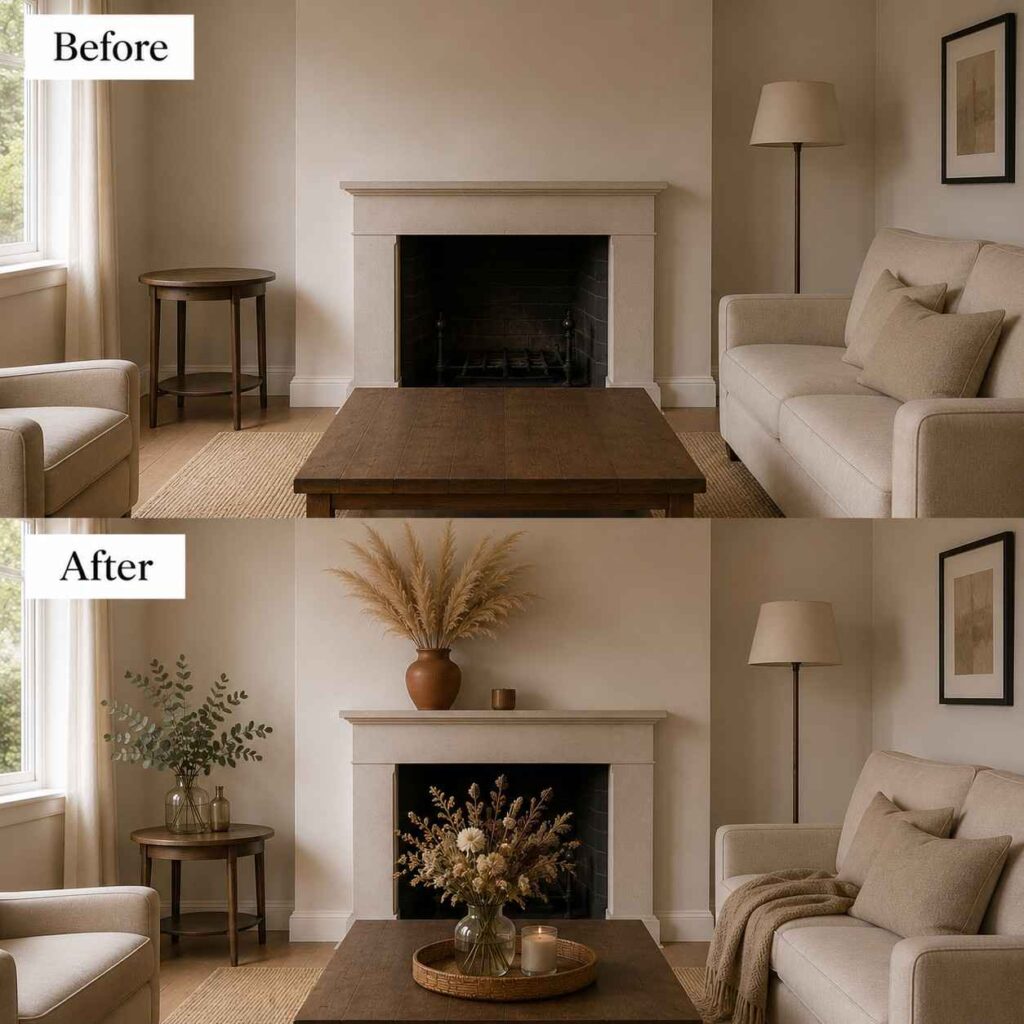
Dried botanicals represent one of the most extraordinary value-for-money styling opportunities in the budget living room makeover — beautiful, naturally textured, genuinely long-lasting (many dried arrangements remain beautiful for years with minimal care), and available at remarkably low cost from discount stores, online marketplaces, and — the best source of all — the outdoors. A walk in a late-summer field, hedgerow, or woodland can yield the raw material for multiple beautiful dried arrangements: grasses, seed heads, branches, berries, and wildflowers that are free to collect and need only hanging upside-down in a dry room for several weeks to transform into genuinely beautiful dried decorative material.
Style tip: Vary the scale of your botanical arrangements dramatically — one very tall arrangement, one medium, and one small — across the different surfaces of the room. Consistent scale reads as timid; variation reads as considered.
14. The $50 Declutter and Edit: The Makeover That Costs Almost Nothing
Budget: $0–$20
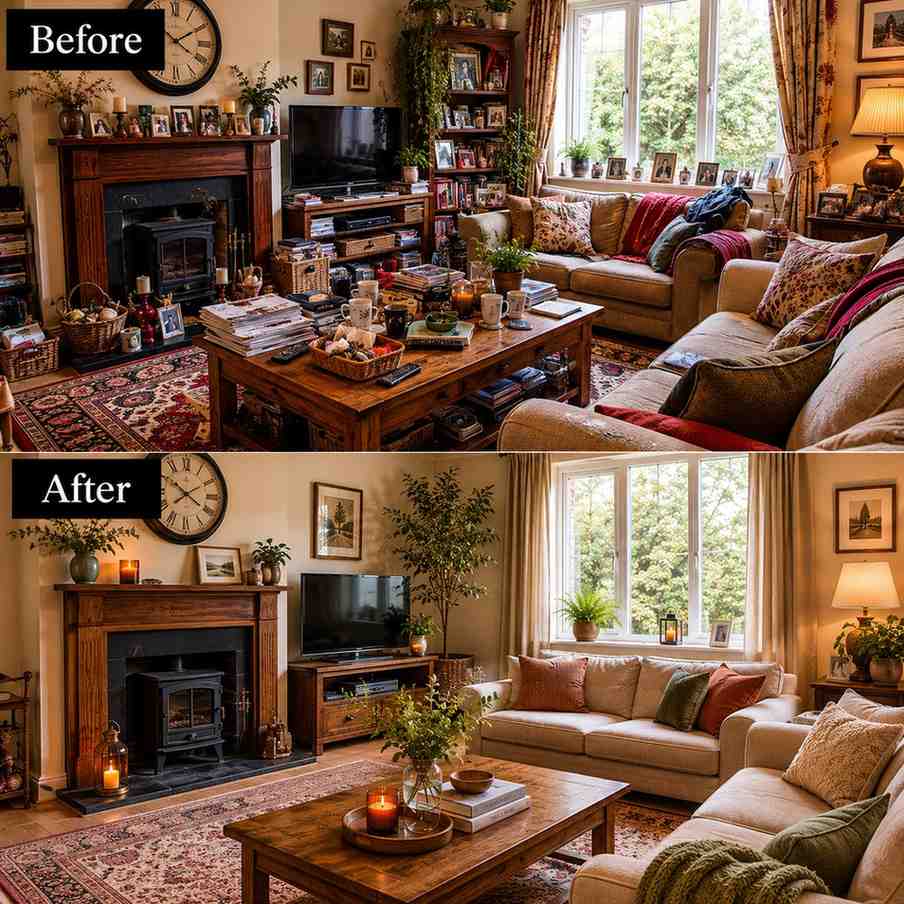
The decluttering edit is the most philosophically challenging but most consistently powerful budget living room transformation available — because it requires not the addition of anything new but the courage to remove what is already there. The living room that is authentically transformed by a rigorous edit will often look, to visitors, as if a significant sum has been spent on new furniture or professional interior design — when in reality the transformation has cost nothing at all beyond the time invested in honest assessment and disciplined removal. This is because the quality that edited, curated spaces communicate — of thoughtfulness, confidence, and restraint — is exactly the quality that expensive interior design is trying to achieve.
Style tip: Before returning anything to the living room after a declutter edit, clean every surface thoroughly — skirting boards, shelves, windowsills, the tops of furniture. The combination of clean surfaces and fewer objects creates a quality of freshness and care that is immediately apparent and deeply pleasurable.
15. The $60 Sofa Cover Makeover: Transforming a Tired Sofa Without Replacing It
Budget: $40–$70
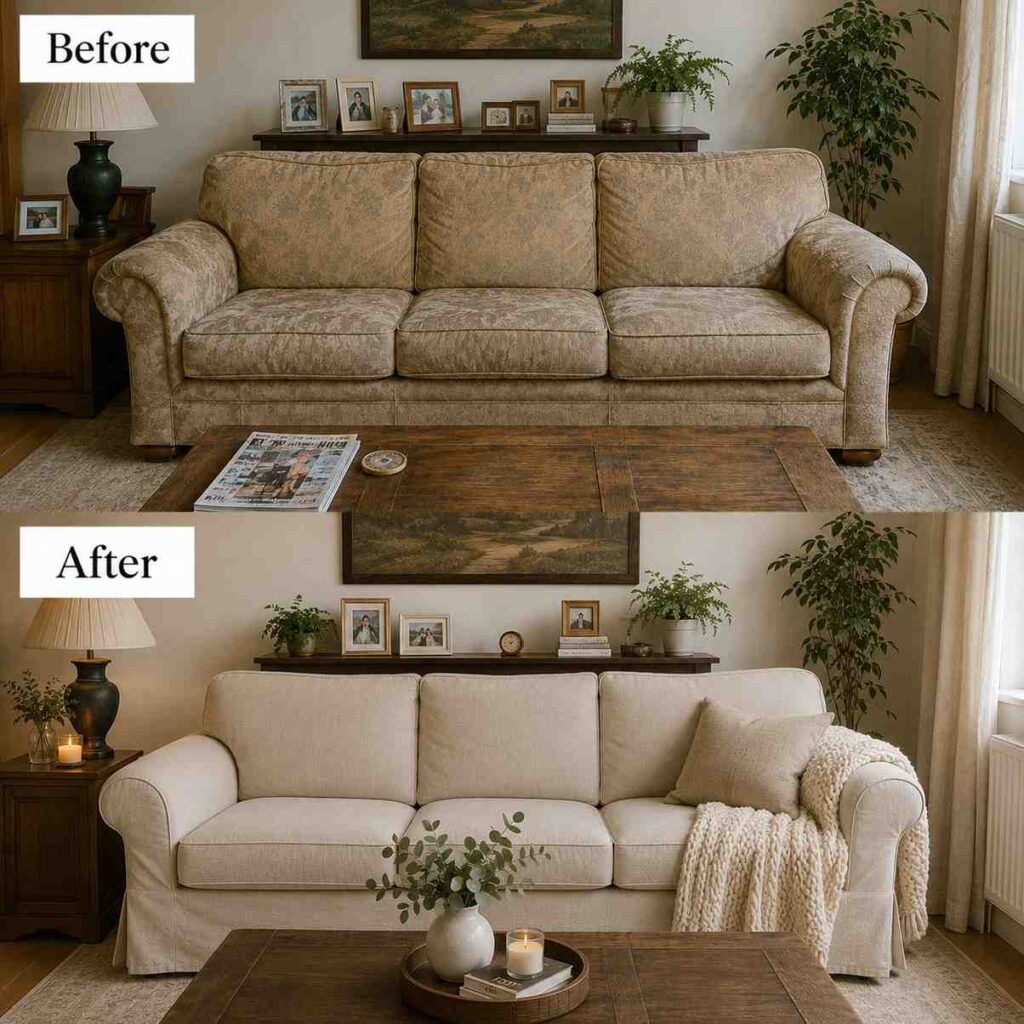
The fitted sofa cover is one of the most effective budget living room transformations available for households where the primary sofa is structurally sound but visually past its best — a significantly less expensive alternative to reupholstery, which can cost hundreds of dollars, and a vastly more aesthetically satisfying alternative to simply living with a tired, faded, or dated sofa. Modern fitted sofa covers, designed to stretch and drape precisely over specific sofa dimensions, have improved dramatically in quality and fit precision over the past several years — the best contemporary versions bear very little resemblance to the loose, ill-fitting slipcovers of previous decades.
Style tip: After fitting the sofa cover, stuff the gaps between cushions and armrests with old bed pillows or foam offcuts to give the sofa a full, plump silhouette — a sofa that looks generously filled reads as significantly more comfortable and expensive than a flat, poorly filled one.
16. The $30 Candle and Ambient Light Upgrade: Evening Magic for Under Thirty Dollars
Budget: $15–$35
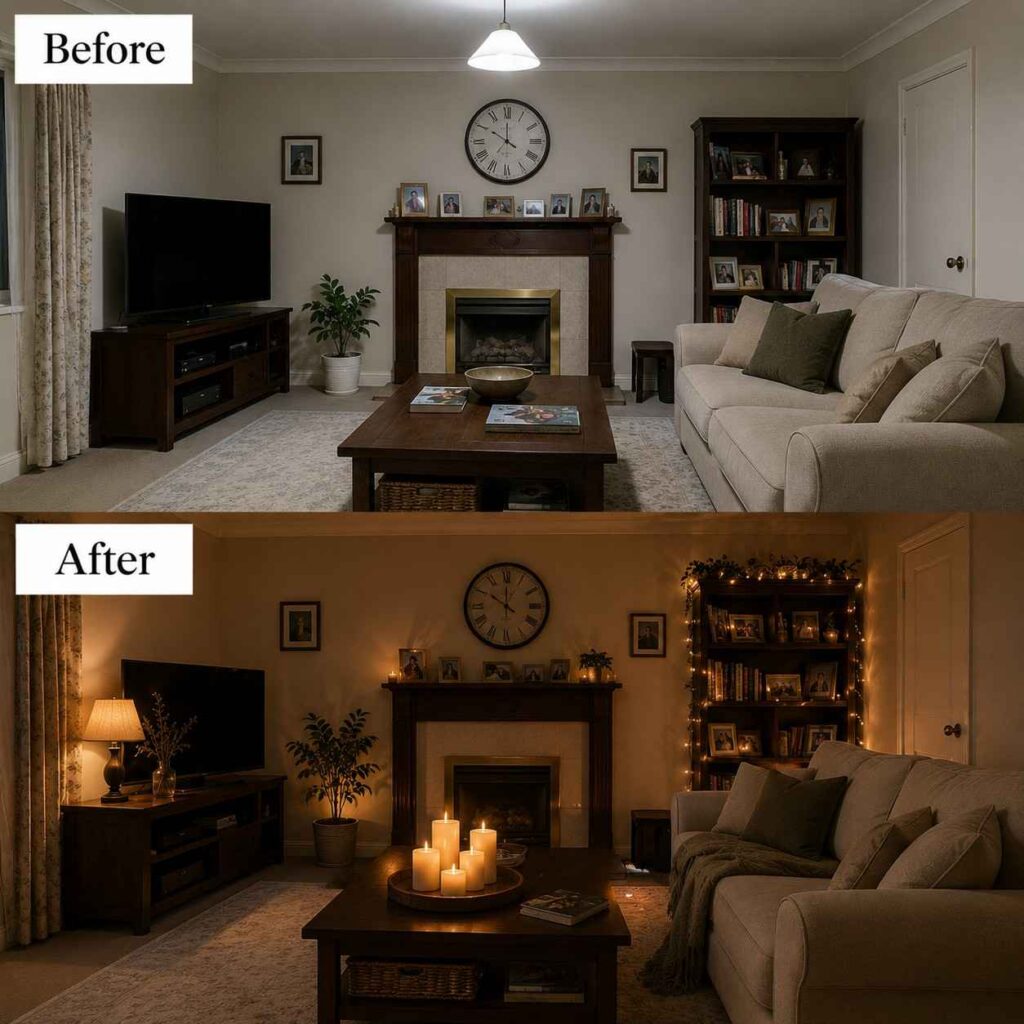
The evening atmosphere of a living room is determined almost entirely by its artificial lighting — and the majority of living rooms are dramatically under-served by a single ceiling light as the primary or only evening light source. The ceiling light, particularly a harsh fluorescent or cool-toned LED, reveals every surface at the same level of brightness, eliminates the atmospheric shadows and warm pools of light that create a sense of warmth and intimacy, and produces the quality of light associated with offices and supermarkets rather than comfortable homes. Transforming the evening atmosphere costs remarkably little — the purchase of candles, string lights, or a single table lamp with a warm bulb is all that is required.
Style tip: Buy a simple single-socket dimmer switch plug — available for under ten dollars from hardware stores — and plug your existing table lamp into it. The ability to dim a lamp transforms it from a functional object into an atmospheric one, and the investment is minimal.
17. The $45 Wall Sticker Mural: Botanical Drama Without Paint or Commitment
Budget: $25–$55
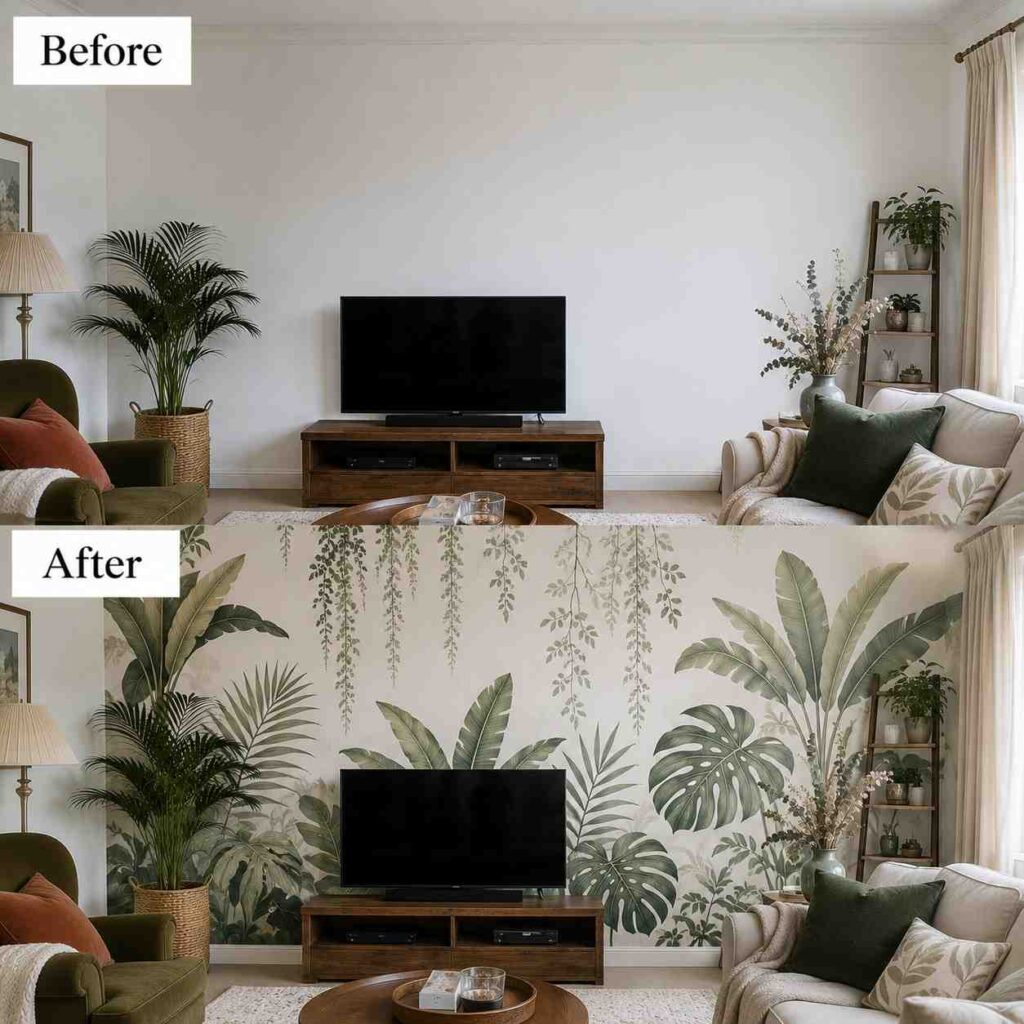
Wall stickers have undergone a radical quality improvement over the past several years and the best contemporary botanical wall sticker sets bear very little resemblance to the childish vinyl decals of the early 2000s. High-quality botanical wall stickers — featuring oversized tropical leaves, climbing monstera, trailing pothos, abstract wildflower forms, and branch-and-leaf designs — are now produced with the print quality of professional illustration and the material quality of removable vinyl that can be applied and repositioned without wall damage. For renters and budget makeover enthusiasts alike, they represent one of the most valuable transformation tools available.
Style tip: Before applying botanical wall stickers permanently, arrange them temporarily with small pieces of repositionable adhesive putty to experiment with the arrangement — once you find a configuration you love, apply the permanent adhesive backing one element at a time.
18. The $40 Ottoman Coffee Table Hack: Multi-Functional Style for Minimal Cost
Budget: $30–$55
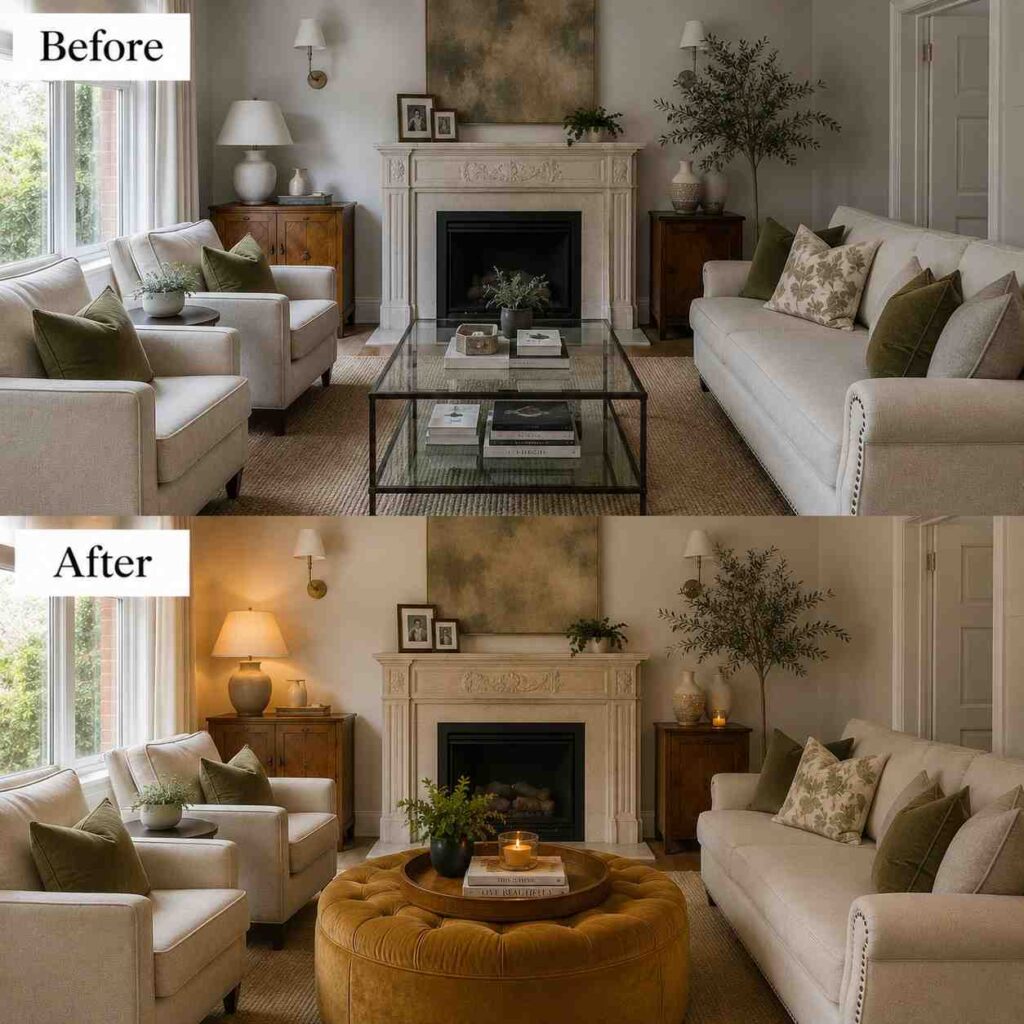
The ottoman-as-coffee-table approach is one of the most practically useful and most visually effective budget living room transformations available — a swap that replaces a cold, hard, visually assertive coffee table with a soft, warm, multi-functional object that improves the usability of the seating area, adds colour and texture to the room’s centre, and functions simultaneously as coffee table surface, footrest for every seat in the conversation grouping, and additional seating when required. Large, round ottomans suitable for use as coffee tables are available from discount furniture retailers and online marketplaces for between thirty and fifty dollars — making this a transformation achievable on almost any budget.
Style tip: Style your ottoman tray with odd numbers — a candle, a plant, and a stack of three books is the classic combination — and ensure that all objects on the tray are in the same tonal family for a cohesive, intentional display.
19. The $35 Floating Shelf Installation: Vertical Storage That Looks Like a Design Feature
Budget: $20–$45
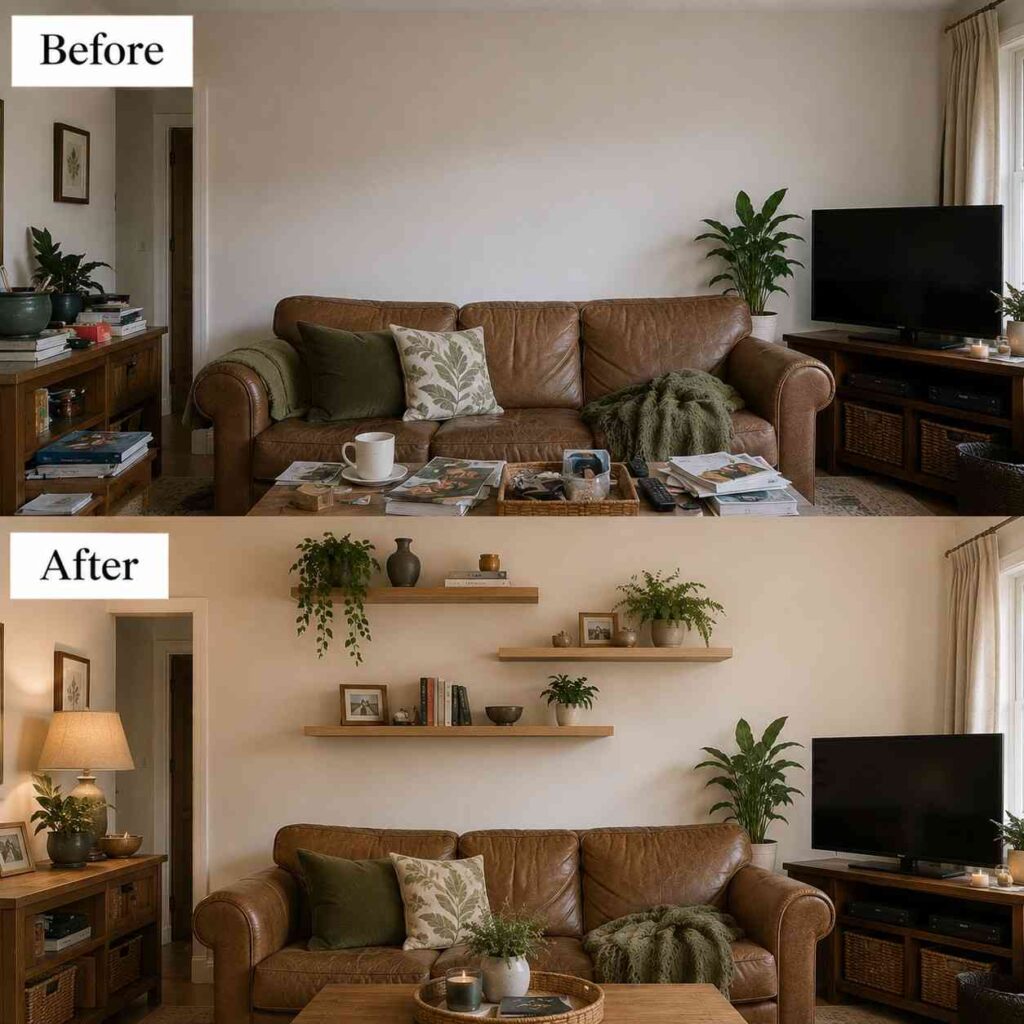
Floating shelves are one of the highest-impact, most practically valuable, and most budget-accessible living room additions available — they add storage, display surface, and visual interest to otherwise blank walls at a cost that is typically between fifteen and forty dollars per shelf, depending on material and length. The installation requires basic DIY confidence — drilling into wall studs, using a spirit level, and operating a power drill — but is achievable by any moderately confident home improver in under an hour per shelf. The result transforms a blank wall into a three-dimensional display surface of genuine architectural interest.
Style tip: Install the lowest floating shelf at a height that allows someone sitting on the sofa to comfortably see and reach the objects on it — approximately 120 to 135 centimetres from the floor — and use the higher shelves for purely decorative display that does not require regular access.
20. The $50 Statement Lamp Addition: Sculptural Light That Changes the Room’s Character
Budget: $30–$60
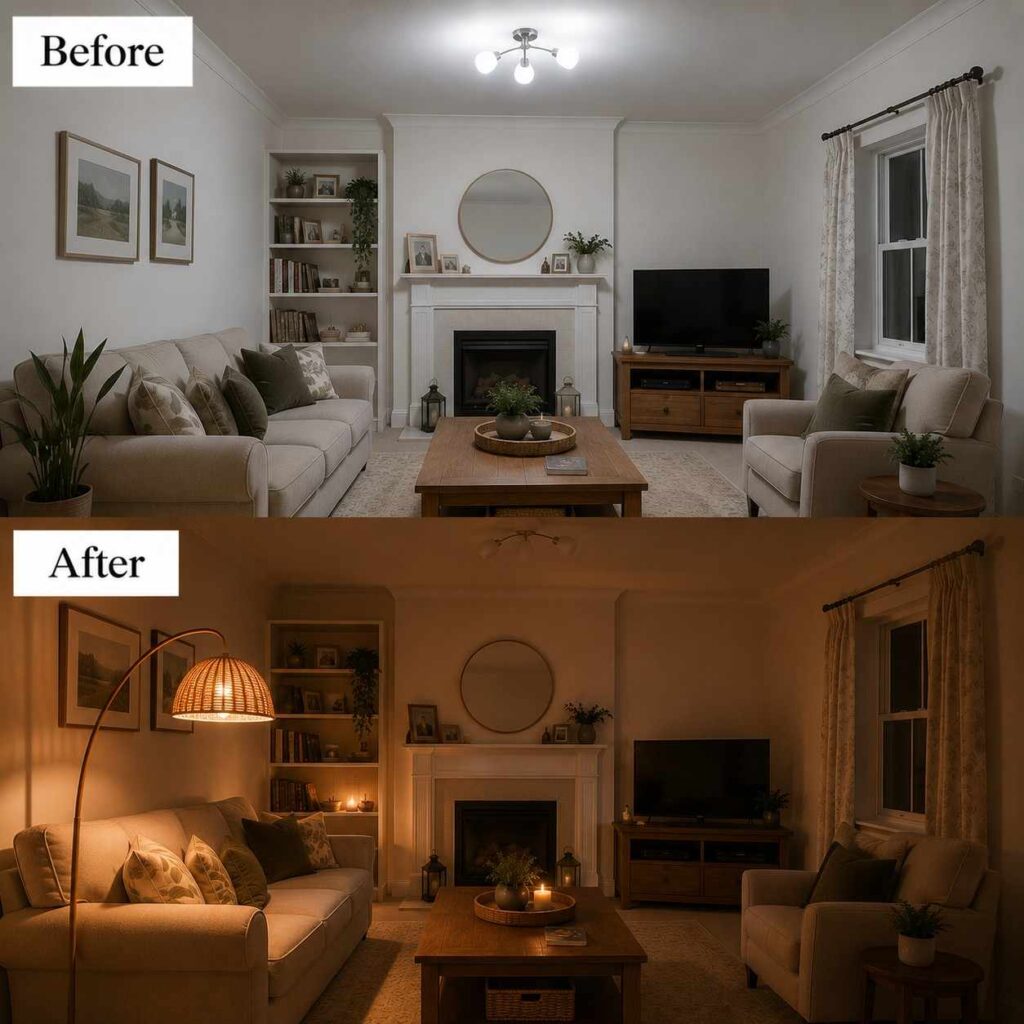
The floor lamp is the most transformative single purchase available at the budget living room makeover price point — a object that simultaneously functions as practical illumination, sculptural vertical element, and atmospheric transformer. Unlike a ceiling light, a floor lamp creates a pool of warm, directional light at a human scale — at the height of a seated person’s eye level — that fills the room with the kind of intimate, gathered-in feeling that overhead illumination can never produce. It also defines the reading nook or relaxation zone within the seating arrangement, giving the person seated beside it a quality of lighting that is genuinely conducive to reading, conversation, and the kind of relaxed inhabiting that a living room should support.
Style tip: Position your floor lamp so that when switched on it creates a distinct visual zone separate from the ceiling light — a reading corner, a relaxation nook, a conversation area. The existence of multiple distinct light zones within a living room is the defining characteristic of a professionally designed lighting scheme.
21. The $20 Washi Tape Feature Wall: Geometric Pattern Without Paint or Commitment
Budget: $10–$25
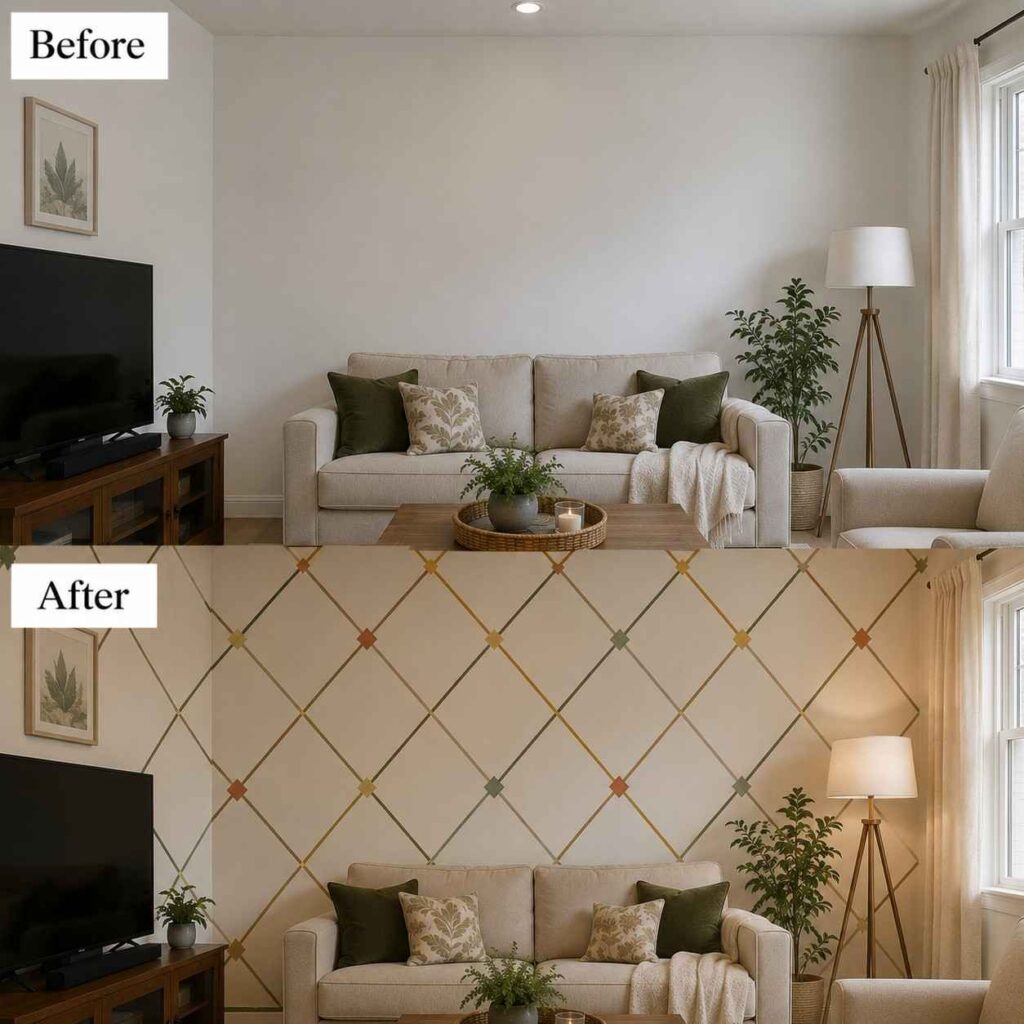
Washi tape — the decorative masking tape originating in Japanese craft culture — has found a remarkable second life as a budget interior design tool, and the washi tape feature wall is one of its most dramatic and most impressive applications. Applied in geometric patterns — chevrons, diamond grids, horizontal stripes, or abstract geometric forms — washi tape transforms a plain wall into something that reads, from room distance, as bespoke hand-applied wallpaper or artisan wall treatment. The material cost is a fraction of any alternative, the installation requires no tools beyond scissors and a spirit level, and the complete removal leaves no wall damage — making this the most renter-friendly large-scale wall treatment available.
Style tip: Seal each strip of washi tape by running a thin line of PVA glue (diluted with water to a 50/50 ratio) along the very edges of the tape with a small brush. This prevents the edges from lifting over time and makes the tape pattern last significantly longer.
22. The $40 Vintage Market Accessories Haul: Character and Charm for Minimal Cost
Budget: $20–$50
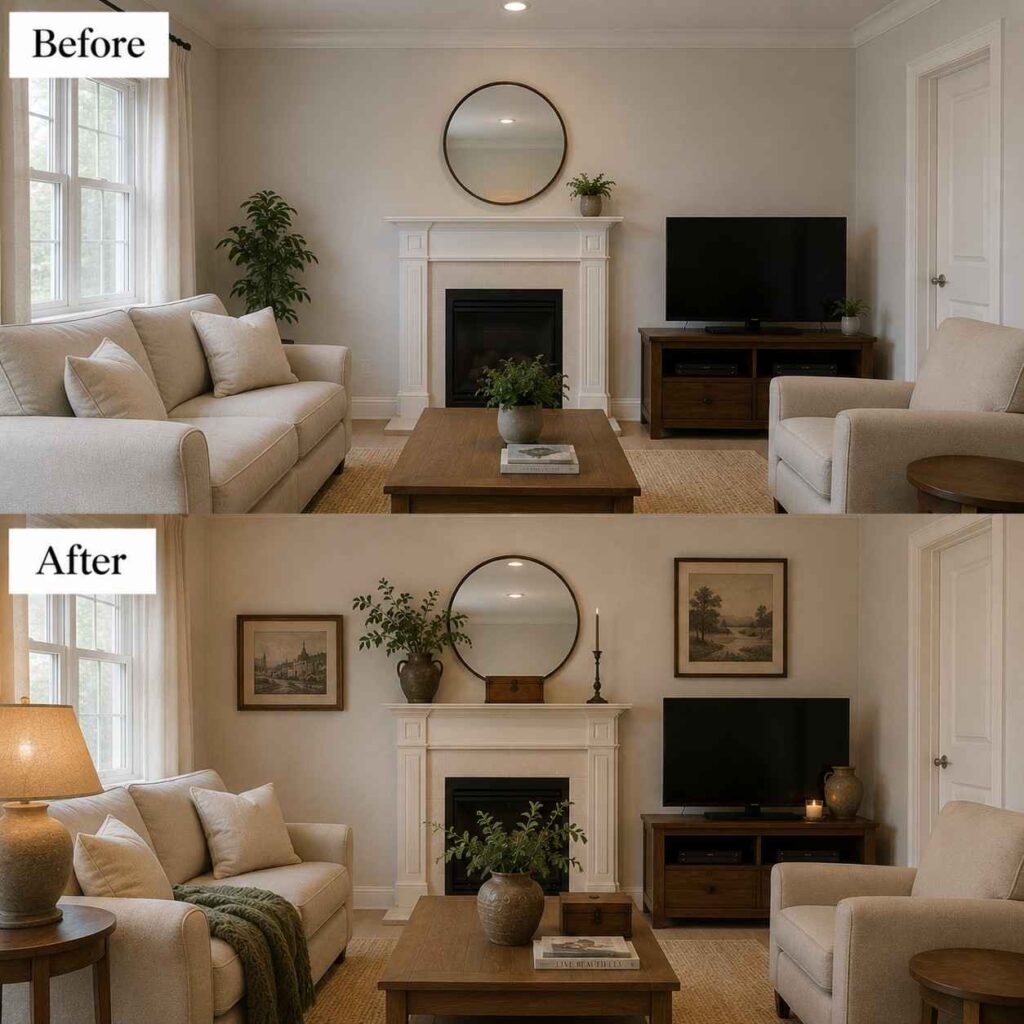
Vintage and second-hand market finds are the living room makeover’s most powerful character-building tool — objects with genuine history, genuine imperfection, and genuine individuality that communicate a specific aesthetic sensibility as no new purchase can. A living room that contains a mix of genuinely vintage objects — regardless of their monetary value — tells a story of aesthetic engagement and personal taste that a room furnished entirely with new items rarely achieves. The patina on a well-used piece of ceramic, the foxing on a vintage print, the worn leather of an old box: these qualities communicate care, discernment, and the kind of considered aesthetic eye that is the foundation of genuinely beautiful interior design.
Style tip: When shopping at vintage markets for living room accessories, always smell ceramics and textiles before purchasing — older items can retain musty or unpleasant odours that are difficult to remove entirely. A ceramic piece that smells musty in the market will continue to smell in the room.
23. The $35 Fabric Wall Hanging: Textile Art That Warms a Room Instantly
Budget: $20–$45
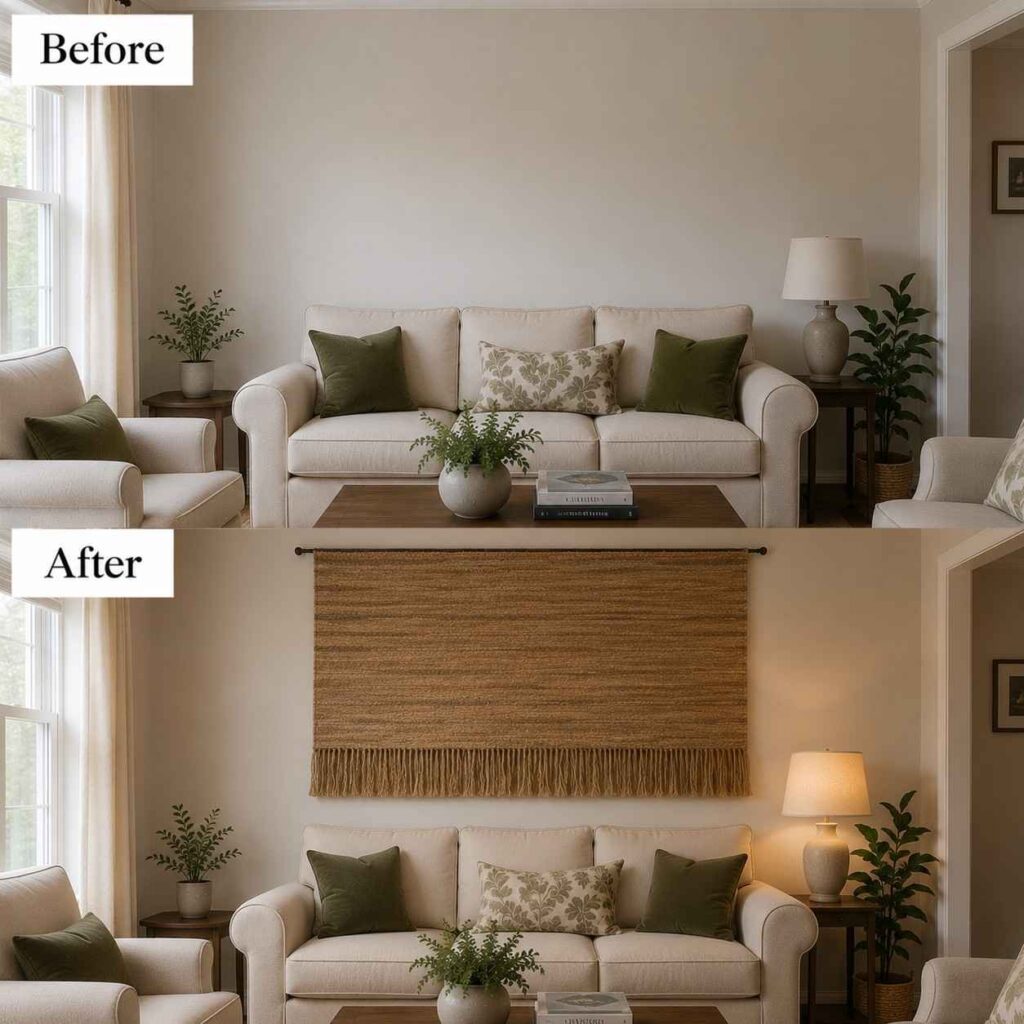
The large textile wall hanging — whether woven macrame, printed fabric, a vintage kilim hung as a tapestry, or a simple length of beautifully patterned fabric suspended from a wooden dowel — solves the blank wall problem with a warmth, scale, and tactile richness that no framed artwork can match. Fabric at wall scale introduces a completely different quality of surface texture into the room — one that absorbs sound (reducing echo from hard walls), adds genuine three-dimensional depth to the wall surface, and creates a warmth of material character that paint, wallpaper, and framed prints cannot achieve. For a large blank wall above a sofa, a well-chosen textile wall hanging often represents the single most effective and most budget-appropriate solution available.
Style tip: For the most natural, flowing wall hanging appearance, do not press or steam the fabric before hanging — the natural wrinkles and soft folds of an unhung textile add to its handmade, organic quality and make it read as genuinely artisanal.
24. The $55 New Sofa Legs Swap: A Ten-Minute Upgrade That Transforms the Whole Sofa
Budget: $25–$60
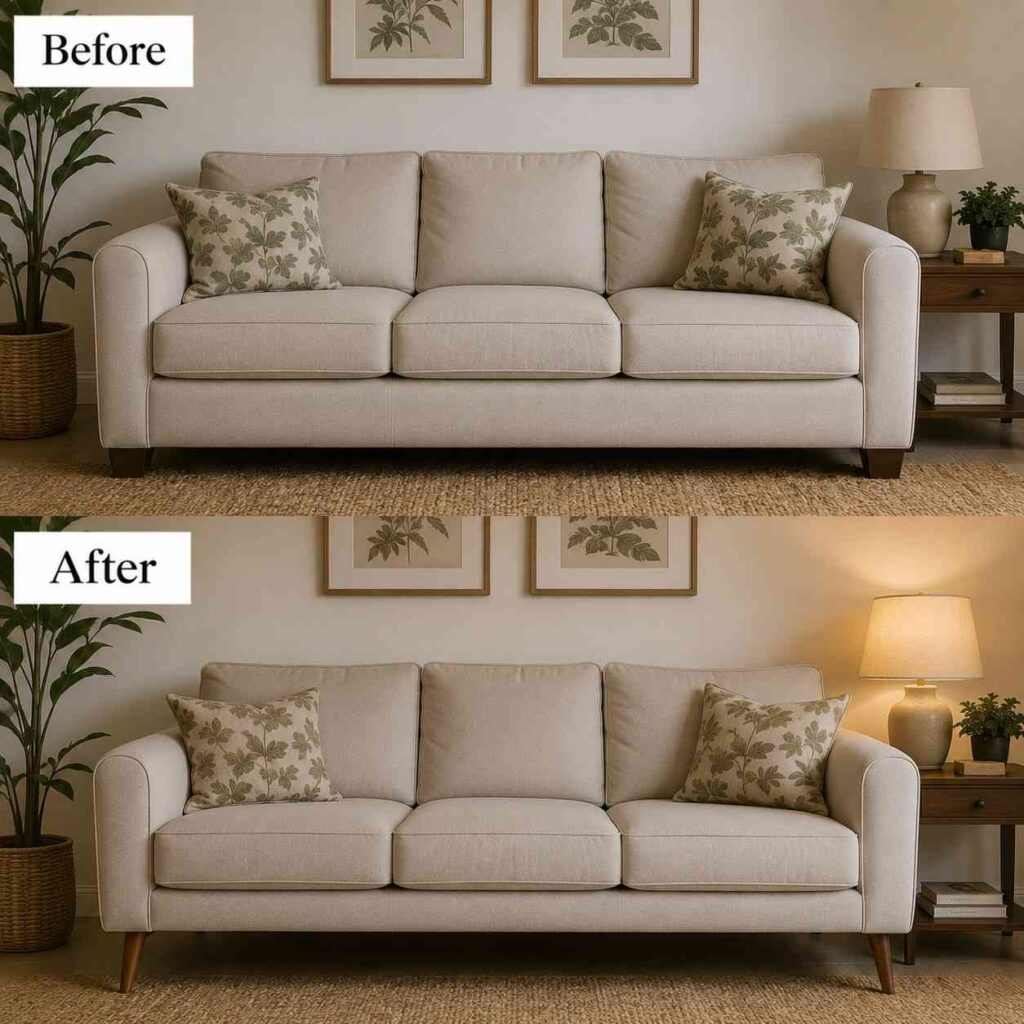
The sofa leg replacement is one of the most brilliantly clever budget living room transformations available — a modification that costs under sixty dollars, takes under fifteen minutes to complete with no specialist tools, and delivers a visual transformation that leads every visitor to the room to assume that a new, much more expensive sofa has been purchased. The technique works because the legs of a sofa are a disproportionately important visual element: they determine the sofa’s silhouette from across the room, communicate its aesthetic category (mid-century modern legs versus contemporary stub legs versus turned Victorian legs), and significantly affect how the sofa relates to the floor and the space beneath it.
Style tip: When replacing sofa legs, choose a height that creates at least fifteen centimetres of clearance between the bottom of the sofa frame and the floor — the visible floor beneath the sofa is what creates the sense of lightness and space that makes a room feel larger.
25. The Complete $200 Living Room Makeover: Putting It All Together for a Full Transformation
Budget: $150–$250 for a complete room
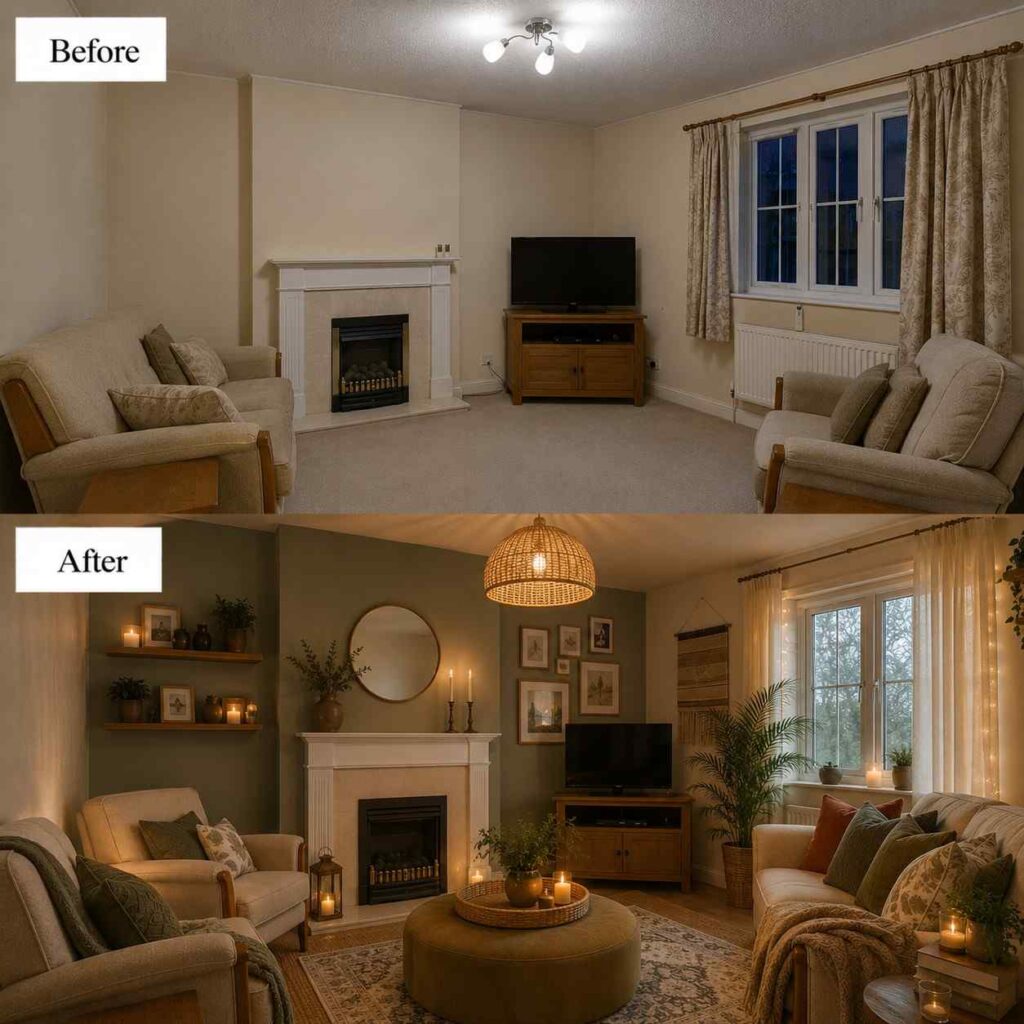
The complete budget living room makeover — applying multiple strategies from this guide in sequence, each building on the improvements of the previous — demonstrates the cumulative power of considered, small-scale interventions executed well. No single one of the twenty-five strategies in this guide produces a complete transformation on its own. But ten strategies applied in thoughtful sequence, each addressing a different aspect of the room’s visual and functional quality, produce a cumulative result that is genuinely remarkable: a room that has been fundamentally changed in character, atmosphere, and quality of inhabitation for an investment that most households can access without significant financial strain.
Style tip: Document the complete makeover with before-and-after photographs from identical angles and at identical times of day — the resulting comparison is genuinely striking and tells the story of the transformation more powerfully than any description. Share on Pinterest with a full budget breakdown for maximum engagement.
Frequently Asked Questions About Budget Living Room Makeovers
What is the single highest-impact budget living room change?
The single highest-impact change that costs money is replacing the ceiling light fitting with a statement pendant and adding a table lamp — the transformation of lighting quality changes how every other element in the room reads and costs under sixty dollars. The single highest-impact free change is rearranging the furniture from perimeter-hugging positions into a floating conversation grouping, which changes the room’s spatial quality and social atmosphere completely at zero cost.
What order should I do budget living room makeover changes?
The most effective sequencing is: (1) free changes first — rearrange and declutter; (2) structural changes — paint, lighting, window treatments; (3) floor covering — rug placement and sizing; (4) soft furnishings — cushions, throws, curtains; (5) accessories — plants, botanicals, gallery wall, decorative objects. Working in this order means that each layer builds on a resolved foundation rather than being added to an unresolved base.
How do I make a small living room look bigger on a budget?
The four most effective small-room-enlarging budget techniques are: (1) hang curtains at ceiling height and wide of the window frame; (2) place a large mirror opposite the window to double apparent light and volume; (3) choose a sofa with legs rather than a floor-length skirt to expose more floor surface; and (4) use a correctly-sized rug with all sofa legs on it to define the floor plan without visually fragmenting it.
What are the most common budget living room mistakes to avoid?
The five most damaging budget living room mistakes are: (1) choosing a rug that is too small; (2) hanging curtains at window height rather than ceiling height; (3) using only a single ceiling light source; (4) pushing all furniture against the walls; and (5) buying too many small, cheap accessories rather than fewer, better ones. Avoiding these five mistakes alone will produce a room that reads as significantly more designed and more expensive than its actual cost suggests.
Can I really transform a living room for under $200?
Yes — genuinely. Idea 25 in this guide outlines a complete room transformation strategy achievable within $150–250 by prioritising the free interventions first, applying paint strategically to one wall, replacing the ceiling light, adding a rug, changing cushion covers and adding a throw, introducing plants and botanicals, and finishing with a gallery wall and candles. The combination of these ten strategies produces a cumulative visual impact that consistently surprises even the people who execute it.
Conclusion: The Room You Deserve Doesn’t Require the Budget You Think It Does
Every living room in this guide started in a state of genuine deficiency — not merely stylistic imperfection but actual visual and functional failure. Harsh lighting. Furniture that communicated nothing. Walls that contributed nothing. Surfaces that accumulated rather than displayed. These are not theoretical problems; they are the lived reality of the majority of living rooms in everyday homes.
And every one of those rooms was transformed — genuinely, dramatically, convincingly — through small, targeted, budget-conscious interventions that cost between nothing and sixty dollars each. The cumulative effect of ten such interventions, applied with a clear palette, a coherent vision, and the discipline to prioritise quality over quantity, is a living room that achieves everything that expensive design aspires to: warmth, personality, visual coherence, and the quality of genuine home.
Your living room is not waiting for more money. It is waiting for a clear vision, a consistent colour palette, a correctly sized rug, a warm light at the right height, a few beautiful plants, and the confidence to remove what is not working rather than adding to it. All of that is available to you right now, with the resources you already have or can access for minimal cost.
Start with one idea. Then the next. Watch what happens.